
What Really Happens During a Programmatic Ad Auction?

You enter the website, and even before all images appear, a market has already been established and closed. People have placed their bets, and one person was picked as a winner, money was exchanged. This all happened before you even got to scroll down a little bit.
An ad auction takes place right here in milliseconds (to be precise, it takes 100-200 ms to happen). This process is very important in digital advertising.
Many marketers are familiar with the concept of Real-time bidding, but might not understand how exactly it works. So, let's shed some light on it.
The Trigger: A Page Load
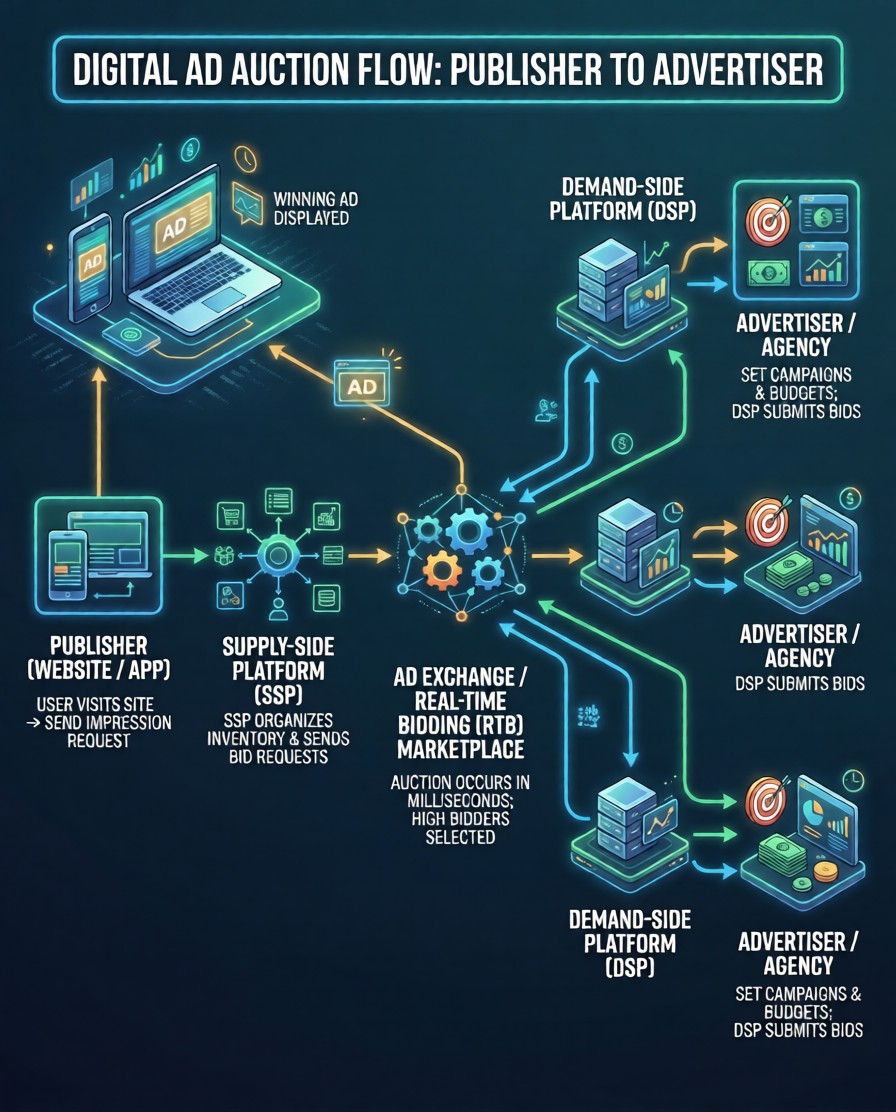
You go to the website that generates revenue from the sale of its ad spaces, and your browser launches the process of loading this website. There is an empty ad space that the publisher, or the owner of this website, wants to sell for maximum profit. And your ad server doesn't just put that ad slot to the highest bidder or advertiser with whom it has a deal previously.
Instead, it sends the signal to the market – and usually, through a Supply-Side Platform (SSP).
Think of the SSP as the middleman on behalf of the ad seller.
The Bid Request
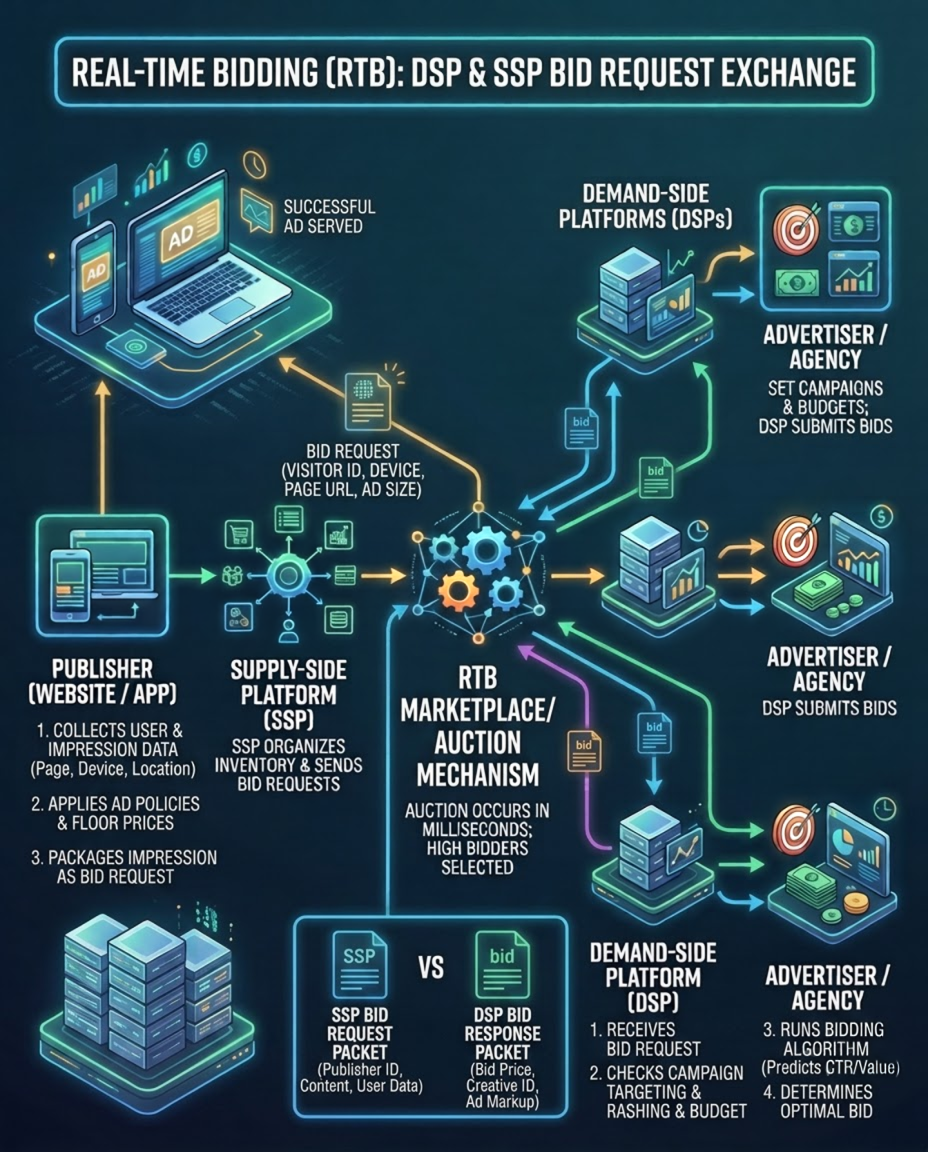
The SSP gathers all the information that is needed and sends bid request to several Demand-Side Platforms (DSP) simultaneously. All the information that is being gathered is about the webpage itself (the topic of the webpage), information about you as about a visitor (e.g. cookies, device id, device features and locale), your browser language, if you are using a mobile or desktop, your age and gender estimation, information about all the ad units present on the webpage, and any other information that can help the buyer make his offer. The DSP, on behalf of the advertisers (brand/agency who has purchased the inventory), uses an algorithm to evaluate impression opportunities based on the criteria of the campaigns and predefined bids.
Also Read: Top AI SEO agencies: five teams that change different parts of the work
Machine learning algorithms will do these calculations instead of a human doing it manually.
The Role of Ad Exchanges
Between the SSP and the DSP, there usually works one of several ad exchanges. Think of the ad exchanges as the stock markets of the advertising industry – the exchanges, with their huge networks of SSP and DSP, have optimised all kinds of transactions for many different publishers and advertisers so that they don't have to build up relationships one-to-one with buyers and sellers.
The Bidding Begins
Each DSP evaluates the incoming bid request against the criteria of the campaign targeting and budget, and calculates the bid value. Factors that affect the DSP's decision-making usually are: how valuable you are to the advertiser, how close his campaign is to meeting its budget, historically what those particular ad units on that particular website cost based on conversion data and how aggressively he wants to compete on this segment. DSPs are competing amongst each other, sometimes even raising the bid a little bit, as it will cost them just one per cent extra but will help them win the ad auction. These are the factors that affect how much they are willing to pay; however, the calculations can differ between each DSP.
The auction finds out who the highest winning bid is based on the bid request and decides upon the winner.
Second-Price Auction vs. First-Price Auction
In the past, most programmatic exchanges used the second-price auction model (common for traditional auction theory). This model supposed that the highest bidder won but paid one cent more than the second-highest bid. It encouraged advertisers to bid higher because they couldn't lose their money if they just outbid another advertiser and paid just a little bit more. In the first-price auction, which is now become the industry standard (as the difficulties of bidding across multiple exchanges made the second-price model less convenient) the highest bidder wins and pays the amount of his bid.
The Winner is Determined. The bid is made, and then a message about it is sent to the winners (as well as to the losing advertisers in order for them to evaluate their bids) who won which impression. The transaction is over. The ad exchange, acting as a middleman, informs the DSP that it won.
The winning DSP in turn contacts the publisher's ad server and gives instructions on where to call for the display of this particular advertisement, usually via CDN.
The ad appears on your web page, and you will never know that a digital auction happened in the background.
Why It Matters?
On a basic level, all of this information sounds like overkill when the objective of the marketer is just to make relevant ads to consumers. Understanding the workings of programmatic ad auctions gives a deeper understanding of why advertising sometimes feels so relevant and other times so irrelevant, as well as why it may cost quite differently. Each intermediary between the advertiser and the publisher has an opportunity to receive a part of the advertising budget as a commission, affecting the actual value of each ad. Transparency reports and supply chain path optimisation have appeared as solutions to increase clarity within the ad tech industry.
In general, programmatic advertising is a sophisticated system that makes millions of dollars in transactions between advertisers and publishers daily in seconds, optimising the complexities of the process.
