
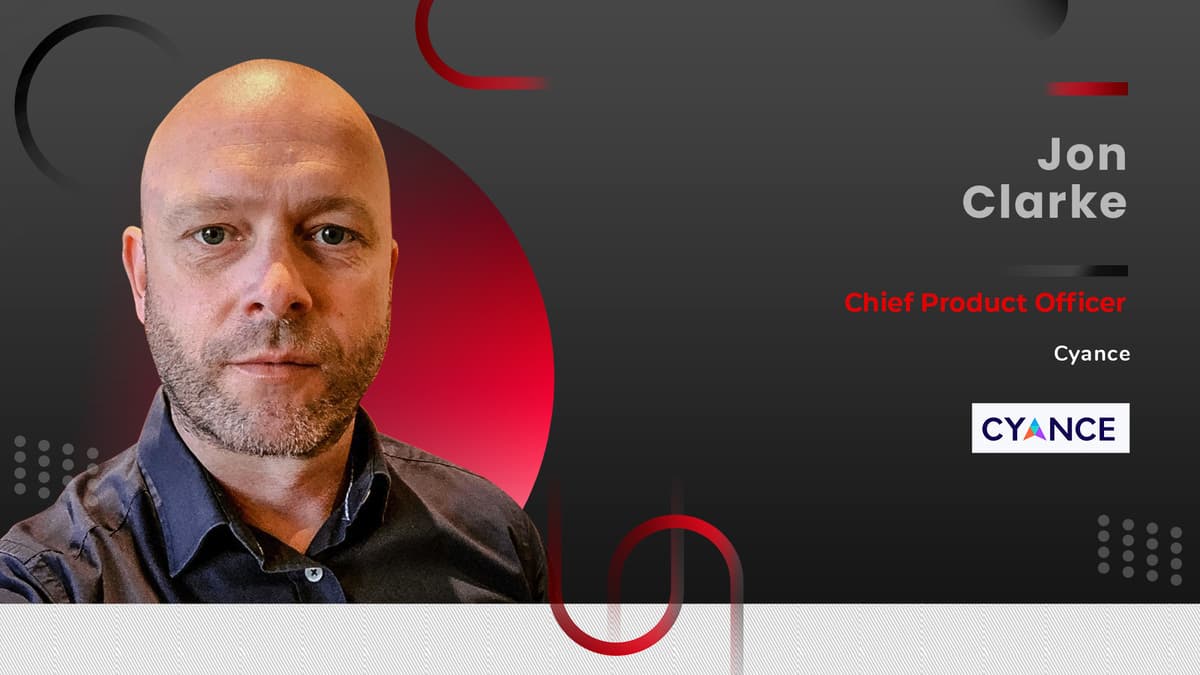
MarTech 360 Interview With Jon Clarke, Chief Product Officer at Cyance
Advertisement
Hi Jon, could tell us about you your journey in MarTech?
Absolutely! I’m the founder and Chief Product Officer at Cyance, a leading B2B Intent & ABM Platform for growth in European markets.
However, my journey in MarTech started over 25 years ago as a sales executive and then in leadership roles. In 2010, I founded a marketing agency that helped challenger brands rapidly gain market share. We soon realised the need for software that helps businesses to find their ideal customers (and their stage of the buying cycle) so that marketing and sales teams could be more relevant, precise, and efficient.
We created Cyance to do precisely that, using data from online behaviour to indicate buyer intent. Our strength lies in providing our customers with customised insights from a vast data pool in multiple languages. These insights help our customers to identify when company behaviour suggests an active and relevant buying journey.
This helps our customers to prioritise what companies they should focus on, when their behaviour suggests they could be in a relevant buying journey. This helps them to positively impact upon customer revenues in the most efficient way.
Today Cyance has blossomed into a SaaS platform used by global multinational companies as well as leading Account Based Marketing agencies.
What challenges has the Covid-19 pandemic Posed for intent marketing?
What luck, I have recorded a video on exactly this topic. What sets Cyance apart from the competition? Custom Intent Keywords: Cyance allows you to track companies that are researching relevant business challenges or goals, which are relevant to your products and services. This behaviour is linked to the content consumption taken from many tens of thousands of websites & publishers. Our support team will help you define the specific keywords and phrases contained within these websites that are deeply relevant to your business – unlike other platforms which insist you select fixed business topics from a generic list. This is important because, with Cyance, you are only tracking account behaviour that is relevant to your specific products and services – rather than running the risk of picking up intent signals from noisy and generic predetermined topics. Multilingual Intent: The only platform that can show you intent in European languages to get a fuller picture. Other intent data providers don’t track non-English content. Instead, they directly translate English-language sites, and in the process lose all the nuance of local language from intent signals. Take literal translations for example – in French, ‘cloud’ would be ‘nuage’. If you’re talking about cloud technology though, you would still use the word ‘cloud’. Cyance is the only platform that supports customisation and intent discovery in multiple languages including French, German, Spanish, Italian and Dutch, with additional languages planned – enabling you to accurately find and target European high-intent buyers. Unbeatable Coverage: Cyance is the leading provider of intent data outside of the US. Our buyer intent signals include over 55,000 sources, with more than 30,000 from Europe. Per fiscal quarter, we track 24 billion B2B data events across Europe and APAC. But what do these numbers mean? Well, when benchmarked by marketing agencies, Cyance was found to track roughly 60% more data than our closest competitors in Europe. Privacy Compliant & Future-proofed: Cyance is 100% GDPR compliant - we profile companies, not people and their personal data. We also recognise and champion the ongoing changes in privacy regulations and our platform is built with future proofed technology to keep pace with the changes in the market. Accuracy of Intent Data: Our data science ensures you get an accurate picture of organisations with intent to purchase, even in the early stages of a committee based buying cycle - while filtering out false positives or those who are not serious about resolving their business problems with products and services like yours. Cyance detects what we call ‘bump’ and ‘crown’ research patterns (named due to what they look like on a graph tracking intent signals), which help identify prospects during the research phase of their buyer journey, providing a ‘golden window’ of opportunity to engage, show thought leadership, be helpful and effectively ‘lead the RFP’ FIT score: Unique to Cyance, the FIT score gives you the ability to quickly determine which accounts are a good fit for your business & in-market, based on a composite score that includes:- Firmographic data – such as geographic area, number of employees, type of organisation, industry and most importantly, technologies deployed internally. If companies have technology installed that your product connects with, is dependent upon, or you have a sales battlecard against, then such insights can help you to segment & target them accordingly.
- Intent score – based on Cyance’s improved data science, using signals from buyer committee behaviour across thousands of online sources.
- Sales Triggers – such as previous engagement with a sales / marketing campaign.
What direction do you envisage ABM taking, in the years to come?
- Cookies will be long gone before the official deprecation. Their role in ABM - for selection and targeting, will need to be rethought.
- Unified IDs will become more of a focus for B2B marketers and ABM
- ABM will become industry standard
- B2B data will switch to a less is more approach
- Data integration will provide a clearer view of the customer
What 3 things that business owners can do to optimize their digital outreach?
- As sales and marketing professionals will have to continue to do more with less, we must also invest our precious few resources on best-fit accounts that are most likely to engage with our brand. Tech must enable us to select accounts for ABM or smart demand gen based on a composite of Firmographic criteria, Technology matches and Intent Data, as well as Engagement signals from your own ads, landing pages and other digital assets.You still need to proactively outreach to your addressable market, where you have establish an ideal customer profile match. That’s what marketing teams are expected to do right? But I’m a fan of prioritising the company showing the most level of relevant intent and engagement to create the demand, most likely to convert into sales revenues.
- Use accurate Intent Data to discover genuine early-stage buyers, while filtering out companies who aren’t serious about finding solutions to genuine problems. Identifying prospects during their early stage research phase of their buyer journey, provides a ‘golden window’ of opportunity to engage, show thought leadership, be helpful and effectively ‘lead or beat the RFP’ to use a slightly outdated phrase. However, this is easier said than done as many intent data providers cannot distinguish genuine committee-based buyer behaviour from false positives in early stages.
- With data privacy regulations coming into effect and browsers moving to block 3rd party cookies, marketers and the digital advertising industry must ensure they follow compliant and future-proof strategies (and technology partners) to build their audiences and conduct ABM. Use future proofed technology that replaces 3rd party cookies with technology like unified IDs, helps you to build 1st party audiences in compliance with privacy laws & helps grow audiences across the digital advertising ecosystem.
As a business leader, what are your thoughts on how ROMI and its use as a metric to define success?
Return on marketing investment (or ROMI) is a great metric to measure the effectiveness of a marketing campaign. However, these days one must not only focus on ROI but on capital-efficient growth – so another great lagging success metric, particularly for SaaS businesses, is CAC:LTV or Cost of Acquiring Customer to Lifetime Value of the customer. I’m a big fan of marketing and sales metrics being totally aligned to what matters most for every business - customer revenues! However, we must approach the measurement of marketing campaigns with caution as things can be a little more nuanced than initially expected, bearing in mind almost all campaigns are multi-touch and omni-channel. Pardon the generalisation, but at least seven touchpoints with the brand are required before conversion so care must be taken to attribute success to the investment made in all channels involved, not just the original point of conversion.It’s probably easier and more manageable to start with building a demand gen strategy for a single channel, like LinkedIn, get it to work, which takes bit of time and then build from there. Don’t be too eager to expand to multiple channels too soon. At this point it’s all about proving increased engagement from your ICP accounts. Then focus on the contribution from marketing towards sales pipeline value and revenues. You should be tracking sourced and influenced by marketing opportunities as success measures at this stage.Your top pick for a book on marketing that everyone should read?
Wow! There are so many! Instead of a book I would recommend people should follow Chris Walker, CEO of Refine Labs. He is prolific on LinkedIn and also hosts a podcast, State of Demand Gen. He nails it every time he posts his thoughts around b2b marketing & sales strategy.Could you name one other marketer that you would like to see featured here?
Declan Mulkeen - CMO at StrategicABM. He’s a super smart CMO and works at an innovative b2b marketing agency in the UK. They are ahead of the game when it comes to all things ABM, Demand Gen and digital.What are the key ingredients that make a successful marketer, in this day and age?
- An understanding of the importance of getting the timing, content and relevance of every marketing message right. Particularly today when we are constantly bombarded with irrelevant and ill-timed marketing messages. We now have the data and insights to do this at pace and with scale.
- An understanding that being helpful rather than being salesy over a sustained period in one’s messaging leads to real thought leadership and brand awareness and credibility - which is a marathon and not a sprint.
- Someone who is unafraid to do things differently to stand out. Never do things ‘just because they have always been done that way’.
- In B2B, you should be obsessed with positively impacting upon customer revenue strategies (acquisition, retention and expansion). Therefore every decision you make around strategy and tactics, should be driven by this obsession. Marketing needs to create demand and positively impact upon sales revenue growth. Establishing what works over time and then optimizing will pay off later on, and avoid too much short-term thinking.
Advertisement