


Imagine presenting your annual marketing results to the board. You confidently discuss channel performance, email open rates soaring, social engagement climbing. The next question is: ‘How did these activities help our pipeline grow?’ Suddenly, the gap between your tracked campaigns and real revenue feels huge. This isn’t just a nightmare; it’s the daily life for many marketing executives. They handle privacy rules, lost cookies, and customer interactions on various devices and platforms. The key solution for coherence, attribution, and real customer understanding is emerging. The identity graph.
Demystifying the Identity Graph
Let’s strip away the jargon. At its core, an identity graph is a sophisticated, continuously updated database. Its main goal is to solve a big marketing challenge: tracking the same person through their various digital and physical paths. Think of every interaction a potential customer has with your brand. They could check your website privately on their work laptop. Then, they might download a whitepaper on their tablet after logging in with a work email. They may interact with your brand on LinkedIn using a personal account. Later, they might call your sales team from their mobile. Finally, they could make a purchase while logged into your app. To traditional siloed systems, these appear as disconnected events, separate ‘users.’ An identity graph connects different identifiers. It links email addresses, mobile ad IDs, social media profiles, cookie IDs, loyalty numbers, offline purchases, and hashed login information. This creates a unified and lasting customer profile.
This isn’t merely a contact list on steroids. It’s a dynamic, living entity. It always takes in new signals. It checks connections and follows changing privacy rules and preferences. It’s important to note the difference between two types of data. Deterministic data shows strong, clear links, like a user logging in with an email. Probabilistic data, on the other hand, is based on patterns. This includes things like using devices often or handling IP addresses. We must use them carefully and ethically. The output gives a complete picture of a person. It helps marketers understand behavior, intent, and value better than any single channel or interaction. 73% of consumers use multiple channels in their buying journey, highlighting how essential cross-device resolution is. Moreover, the U.S. investment in identity solutions is expected to reach US$ 8.2 billion by 2024.

Identity-powered systems can deliver up to a 70% lift in conversion rates, and up to 32x for sparse data identifiers.
Why Identity Graphs Are Non-Negotiable in Today’s World
The need for identity resolution isn’t just about convenience. Big changes in the digital world have shaken up traditional marketing methods.
- The End of the Third-Party Cookie: Digital tracking and ad targeting have depended on this for years, but now it’s breaking down. Major browsers have limited or removed third-party cookies. This change disrupts the main way to track users online. Relying on this crumbling infrastructure is no longer viable. Over 85% of global web traffic is expected to be cookie-restricted by 2025.
- The Privacy Revolution: GDPR, CCPA, and other privacy laws require clear user consent for data collection and use. Consumers are more aware and concerned about their data than ever. Marketing that relies on unclear tracking is not effective. It can also be risky, leading to big fines and harm to your reputation. Ethical identity graphs use first-party data and consented signals. They are the safe way to ensure compliance. Apple’s App Tracking Transparency sees just 25% of users opting in, and Android is expected to follow.
- Explosion of Channels and Devices: The modern customer journey is a complex web. A B2B buyer engages with content on LinkedIn, industry sites, vendor pages, emails, webinars, and in sales talks. They often switch between different devices. Siloed data gives a distorted, incomplete view. This can lead to wasted money and unhappy customers. For example, you might get a discount on a product you just returned.
- The Attribution Black Hole: Linking early anonymous research, like a website visit or content download, to a demo request is hard. Then, tying it to a closed-won enterprise deal months later is even tougher. This is mainly due to the lack of consistent identity. This obscures true marketing ROI and makes budget justification an uphill battle. B2B buyers use many channels before making a purchase. So, figuring out influence without an identity graph is mostly guesswork.
Ignoring this shift has clear consequences. Marketing becomes less effective and more wasteful. It also disconnects from real customer relationships and business results. An identity graph is the essential infrastructure to navigate this new reality. Only 31% of marketers feel fully satisfied with their ability to unify customer data for campaign building and performance analysis.
Also Read: Digital Customer Journey Mapping: How to Optimize Every Touchpoint for B2B Success
Beyond Basic Targeting
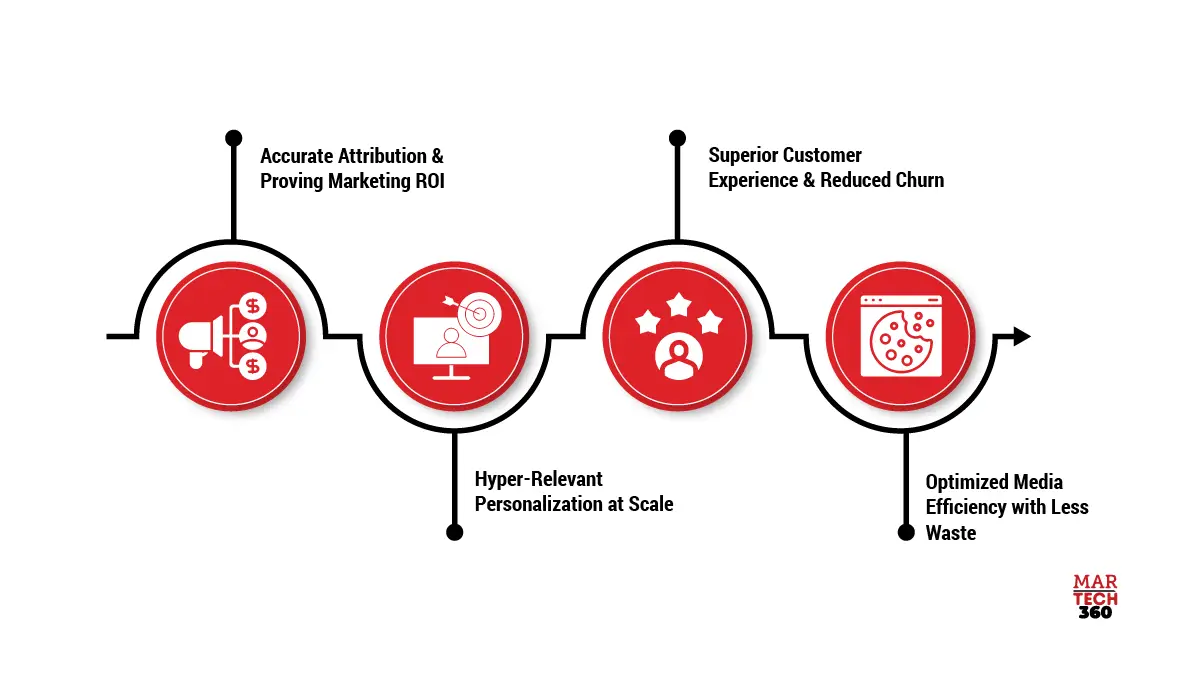
For CMOs, VPs of Marketing, and senior leaders, an identity graph is more than just ‘better ads.’ It offers transformative abilities throughout marketing:
- Accurate Attribution & Proving Marketing ROI: This is key for securing budget and making a strategic impact. An identity graph shows the full customer journey. Anonymous actions, like checking a product page or joining a virtual event, can boost sales and revenue. Consider that a US$ 500,000 enterprise deal didn’t just come from the last sales call. It actually started with a specific industry report download six months earlier. This was made possible by targeted LinkedIn ads. This detailed insight helps with budget decisions. It shifts money from weak channels to strong activities. It also shows how marketing adds to profits. A global SaaS provider tied a multi-million-dollar contract to an anonymous whitepaper download seen in their graph. This discovery changed their content strategy investment.
- Hyper-Relevant Personalization at Scale: Customers want relevance but dislike feeling watched. An identity graph powers personalization that feels helpful, not intrusive. To really know someone, check their past interactions. Also, consider what they read, their purchase history, and their interests. This way, you can create personalized experiences at every touchpoint. This means sharing great content, offering a helpful discount, or providing early support. Imagine a B2B scene. A prospect downloads a technical guide from your site. Later, they get an email inviting them to a detailed webinar about that topic. Also, a sales rep gets notified about the prospect’s interest before the call. This relevance boosts engagement, conversion rates, and customer satisfaction.
- Superior Customer Experience & Reduced Churn: Identity resolution breaks down internal silos. When marketing, sales, and customer service see the same view of the customer, things run smoothly. This often happens when the graph connects with CRM and CDP platforms. Marketing avoids sending irrelevant promotions to customers’ service just helped with a problem. Sales understands the prospect’s full engagement history. Service can anticipate needs based on past behavior. Critically, identity graphs enhance retention efforts. Link support chats, like when customers talk about a competitor’s price, to marketing data. You can begin targeted retention campaigns or personalized offers before churn happens. A fintech company cut cancellation rates by using their graph. They found customers showing signs of support linked to leaving. Then, they stepped in early to help.
- Optimized Media Efficiency with Less Waste: In a cookieless world, identity graphs help target ads. They also reduce ad waste across paid channels. You can target your known customers or valuable lookalike audiences on different platforms. You can also exclude current customers from acquisition campaigns. This saves a lot of budget. This precision boosts campaign performance. It enhances metrics such as Cost Per Acquisition (CPA) and Return on Ad Spend (ROAS). Also, frequency capping across channels is possible. This helps prevent ad fatigue and improves how people see the brand.
Building Your Identity Foundation

Deploying an effective identity graph requires careful planning and strategic choices. Here’s where marketing leaders should focus:
- Use Your First-Party Data: Your first-party data is essential.
This includes:
- Email addresses
- Phone numbers
- Customer IDs
- Login info
- Purchase history
- Support tickets
- Webinar attendance
This authenticated information provides the strongest connections. Focus on gathering this data ethically by offering value in return. Use engaging content, tailored experiences, and loyalty programs. Get personal recommendations based on your interests. Just share your email.
- Architecture Choice: Build, Buy, or Hybrid? This is a critical decision with significant resource implications. Creating an in-house solution gives you full control and customization. It requires a big investment in data engineering skills, infrastructure, and ongoing maintenance. This is especially true for large companies like Walmart. Using identity resolution providers like LiveRamp, Neustar, or Merkle can speed up your results. They come with built-in compliance and access to larger consented data networks. However, this might limit customization options. A hybrid approach is common. It uses a partner for core resolution and adds proprietary internal data. Evaluate your internal resources, budget, timeline, and desired level of control.
- Privacy & Consent as Core Principles, Not Afterthoughts: This is non-negotiable. Design your identity graph with privacy-by-design principles. Ensure strict adherence to GDPR, CCPA, and other relevant regulations. Implement robust consent management platforms (CMPs) to capture and honor user preferences granularly. Be transparent about data usage. Offer easy opt-out mechanisms. Trust is your most valuable currency. When you violate it, you weaken your graph’s foundation. Anonymize or group data when you can. This helps in analysis and targets segments without needing to identify individuals.
- Start Focused, Then Scale: Don’t attempt a full-scale, enterprise-wide rollout immediately. Begin with a high-value use case or specific customer segment. Pilot testing helps you confirm the technology works. It shows quick wins, improves processes, and gains support within the team. For example, work on bringing together customer journeys for retention campaigns. Also, track how anonymous users become known during a key product launch. Use the results and learnings to expand systematically.
- Integration is Key: An identity graph shines when linked to your marketing tools. This includes your CRM, like Salesforce. It also covers Marketing Automation Platforms such as Marketo or HubSpot. You’ll also find Customer Data Platforms (CDPs), advertising platforms (DSPs), and analytics tools here. Ensure seamless data flow between systems to activate insights across the customer lifecycle.
Identity as Strategic Imperative
 Adopting an identity graph is more than just using new technology. It marks a big change toward a customer-focused, privacy-friendly, and responsible marketing approach. In a world where poor marketing drives customers away, great experiences bring them back. The identity graph is key to making this happen.
As you consider solutions, ask yourself: Does this option prioritize privacy and consent? Can it effectively integrate both online and offline data signals? Is it flexible enough to add future channels and identifiers beyond what we have now? How will it scale with our business ambitions?
A Fortune 500 retail CMO shares his thoughts on change: “Before our identity graph, we marketed to disconnected ghosts. We only saw bits of people across different systems. Now, we’re building real relationships with individuals. We understand their needs and deliver value at every step. It’s changed not just our marketing efficiency, but our entire philosophy.”
The Essential Takeaway for Marketing Leadership
The fragmentation of customer identity is the defining challenge of modern marketing. In a privacy-first world without cookies, old methods don’t work well. You risk falling behind. An identity graph is more than just a tech tool. It connects separate signals into useful customer insights. It helps with accurate attribution and allows for respectful personalization. In the end, it boosts sustainable revenue growth.
Marketing leaders must act now. They need to show their strategic value. This will help them build real customer loyalty. Also, they must prepare for the challenges of the digital future. Audit your current data landscape. How effectively can you connect the dots across the entire customer journey? If there are big gaps in the answer, make a strong identity resolution strategy your top priority. Your future success in understanding, engaging, and retaining customers depends on it.
Comments are closed.