

The more exposure you have to different parts of that ecosystem whether it’s data, design, engineering, or customer-facing work the better prepared you’ll be able to connect the dots.
Can you tell us about your professional background and your current role at IQM? Also, tell us how IQM differentiates itself from other companies in the same space.
I’ve been in the ad-tech industry for about 15 years. My career always centered around building products at the intersection of data, AI, advertising, and technology. Over the years, I’ve worked across the full spectrum of ad-tech DSPs, DMPs, pre-bid data, and email marketing which has given me a broad perspective on how different parts of the ecosystem connect and evolve. What’s been consistent throughout is my focus on creating solutions that aren’t just innovative but also make life easier for customers and deliver clear business outcomes.
At IQM, I lead product strategy and execution. What excites me about this role is that we operate in highly sensitive verticals like political and healthcare. It’s not just about building a programmatic platform, but doing it in a way that’s compliant, transparent, and still delivers measurable value for advertisers.
When it comes to differentiation, most DSPs in the market are fairly generic they execute campaigns across every industry in the same way. IQM takes a different approach. We go deep into each vertical, tailoring the platform to its unique compliance rules, data requirements, and advertiser needs. At the same time, we’re embedding AI across the platform not as a buzzword, but as a way to simplify workflows, make smarter decisions, and deliver better outcomes. That vertical expertise, combined with AI-driven innovation, is what truly sets IQM apart.
Looking back at your 15 years of experience across data, AI, ad-tech, and mar-tech, how has that background shaped your approach to leading IQM’s political media buying platform?
One of the biggest lessons I’ve learned is that innovation has to go hand in hand with trust. In ad-tech, it’s easy to chase scale or efficiency, but if the data isn’t reliable or the methods aren’t transparent, customers won’t stick around. Another lesson is the importance of simplicity. We work in an industry filled with complexity, and I’ve seen firsthand that products win when they make things easier for customers, not harder.
These lessons are especially relevant in leading IQM’s political media buying platform. Politics is a highly sensitive and regulated vertical, where compliance, accountability, and usability all matter deeply. My approach has been to take the broad perspective I’ve gained across the industry and apply it to build a platform that ensures accuracy, safeguards against fraud, operates within strict regulatory guardrails, and delivers transparent reporting with actionable insights.
Serving verticals like politics at IQM comes with unique compliance and privacy constraints. What are the biggest hurdles in developing products for these sectors, and how do you ensure product-market fit while maintaining regulatory integrity?
The biggest hurdle in developing products for regulated verticals like politics is that you’re not just building for performance you’re building under a microscope. Every feature has to meet strict compliance standards, protect user privacy, and still deliver measurable outcomes for advertisers. Unlike other verticals, the margin for error is very small. A compliance misstep can damage credibility, and overly complex workflows can discourage adoption.
The way I approach this is by making compliance and usability part of the product design from day one, not an afterthought. At IQM, that means embedding the necessary guardrails into the platform while still giving campaigns the flexibility to plan and execute effectively. To ensure product-market fit, I stay close to customers testing ideas early, gathering feedback, and validating that we’re solving real problems rather than just meeting regulatory checkboxes. It’s about striking a balance: giving campaigns tools they trust and regulators confidence in the process, while keeping the experience simple enough for teams to adopt quickly.
Also Read: MarTech360 Interview with Miruna Dragomir, Chief Marketing Officer at Planable
With third-party cookies declining and regulations like GDPR and CCPA, how is IQM adapting its targeting and identity resolution strategies while keeping products effective and compliant?
While third-party cookies technically still exist, their effectiveness has declined due to browser restrictions, privacy regulations, and changing user expectations. That’s why at IQM, we’ve been focused on building privacy-first alternatives. The old model of relying on persistent identifiers is no longer sustainable in an environment where compliance and transparency are just as important as performance.
Our approach combines multiple strategies. We are looking into cohort-based targeting, clean room integrations, and advanced modeling techniques that don’t depend on individual identifiers. We also recognize that external identifiers, such as RampID or UID2.0, can play a role, though their long-term value will depend on scale, interoperability, and user trust. At the same time, we are embedding predictive and contextual AI models into the platform, enabling advertisers to analyze signals in real time, generate insights, and achieve relevant outcomes without crossing privacy lines.
From a product perspective, my focus at IQM is on balancing two priorities: delivering the campaign performance advertisers expect, while ensuring the methods respect both regulations and end-user trust. That balance is what ultimately defines the future of identity and targeting in regulated media buying and it’s where IQM is positioning itself as a leader.
With privacy regulations tightening, what role do you see AI playing in building trust with users in ad-tech?
Privacy has become one of the defining themes in ad-tech, and AI has a big role to play in helping us build trust with users. For years, advertising relied on collecting as much data as possible and then figuring out what to do with it. That approach doesn’t work anymore not only because of regulations, but also because users expect more choice and control.
AI helps us move from “data hoarding” to “data intelligence.” Instead of storing every signal, it can analyze patterns in real time, work with smaller or anonymized datasets, and still deliver relevant results. For example, predictive modeling can fill gaps when identifiers are missing, and cohort-based targeting can enable personalization without exposing individual identities. Just as important, AI can explain why a user saw an ad or what data was used, which gives people confidence that the system is fair and accountable.
In the end, trust comes from respecting user expectations. AI gives us the tools to deliver performance responsibly, in ways that protect privacy while still creating value for advertisers.
How do you see AI reshaping product management in ad-tech?
AI is reshaping product management in ad-tech in a very fundamental way. Traditionally, a lot of product work here was about data and scale how to process billions of impressions, how to target more precisely, how to generate faster and detailed reports, and how to make sense of massive datasets.
Today, AI allows us to go beyond data and scale into intelligence. It helps in two big ways. First, it improves existing workflows, making them faster and more intuitive for example, generating a report instantly with a chat interface instead of requiring endless filters and clicks. Second, it uncovers insights and makes decisions on its own, like automatically adjusting bids or budgets in real time.
In ad-tech, this shows up across the entire lifecycle: campaign creation, audience building, reporting & attribution, fraud detection, predictive modeling, and deriving insights. For product managers, the shift is clear we’re moving from designing tools that execute instructions to building systems that think, learn, and recommend. And that comes with both opportunity and responsibility: the opportunity to drive smarter, faster outcomes, and the responsibility to ensure the AI remains transparent, ethical, and aligned with customer and business goals.
What KPIs or metrics do you personally track to gauge the success of a new product launch?
For me, the success of a product launch is about whether it creates real value for customers and for the business. So I look at a mix of adoption, engagement, and outcomes. Adoption tells me if customers are actually trying the product. Engagement shows whether they’re finding enough value to keep using it. And outcomes measure if the product is delivering on the promise we made, whether that’s efficiency gains, better targeting, or improved campaign performance.
I also pay close attention to qualitative feedback in the early stages. Numbers can show you what’s happening, but conversations with customers tell you why. Hearing directly from them helps me refine the product quickly and ensures we’re not just chasing vanity metrics. In short, my KPIs combine quantitative signals like usage, retention, and performance with qualitative feedback that gives context and direction for the next iteration.
As a product leader, how do you foster a product culture that encourages innovation, ethical design, and responsiveness to evolving industry needs within your team?
For me, culture starts with clarity and empowerment. People do their best work when they understand the “why” behind what we’re building and feel trusted to own their part of the solution. I set a clear vision, then give teams the freedom to experiment, test quickly, and learn from both successes and failures.
Ethical design is part of that culture from day one. In ad-tech, we’re not just building for advertisers we’re also influencing end-user experiences. I encourage my teams to ask early: Is this transparent? Are we respecting privacy? Could this be misused? Raising these questions upfront makes ethics a natural part of the design process.
Responsiveness comes from staying close to the market. Regular customer conversations, feedback loops, and cross-team collaboration help us adapt quickly as industry needs evolve. When curiosity and accountability are built into the culture, the team can stay ahead of change instead of reacting to it.
Having navigated diverse roles across many industries, what advice would you give to aspiring product managers who want to work in ad-tech or AI?
My first piece of advice is to build breadth in your experience. Ad-tech and AI are complex spaces where technology, data, compliance, and user experience all come together. The more exposure you have to different parts of that ecosystem whether it’s data, design, engineering, or customer-facing work the better prepared you’ll be able to connect the dots. A great product manager in this space isn’t just a feature owner, but someone who can translate complexity into clarity for both teams and customers.
Second, stay curious and adaptable. The industry changes so quickly what worked yesterday may not work tomorrow. If you treat every shift, whether it’s privacy regulations or a new AI breakthrough, as an opportunity to learn, you’ll thrive. And finally, never lose sight of trust. Whether you’re building in ad-tech or AI, the responsibility is bigger than shipping features. You’re designing systems that shape decisions, experiences, and sometimes even public opinion. Keeping ethics, transparency, and customer outcomes at the core will make you not just a good product manager, but a respected one.
What do you enjoy most about being a product leader, and what continues to inspire you in this journey?
What I enjoy most about being a product leader is seeing an idea go from a whiteboard sketch to something real that customers use and value. There’s a special moment when you hear feedback like, “this solved a real problem for us” that’s the kind of impact that makes all the hard work worth it. I also enjoy the journey of building with a team, where different perspectives come together to create something none of us could have built alone.
What continues to inspire me is the pace of change in our industry. Ad-tech and AI never stand still, and that means there’s always something new to learn, some new challenge to solve, or some better way to serve customers. For me, that constant evolution is energizing. It keeps me curious, it pushes me to keep growing, and it reminds me why I chose this path in the first place.
Thanks, Dhimant!
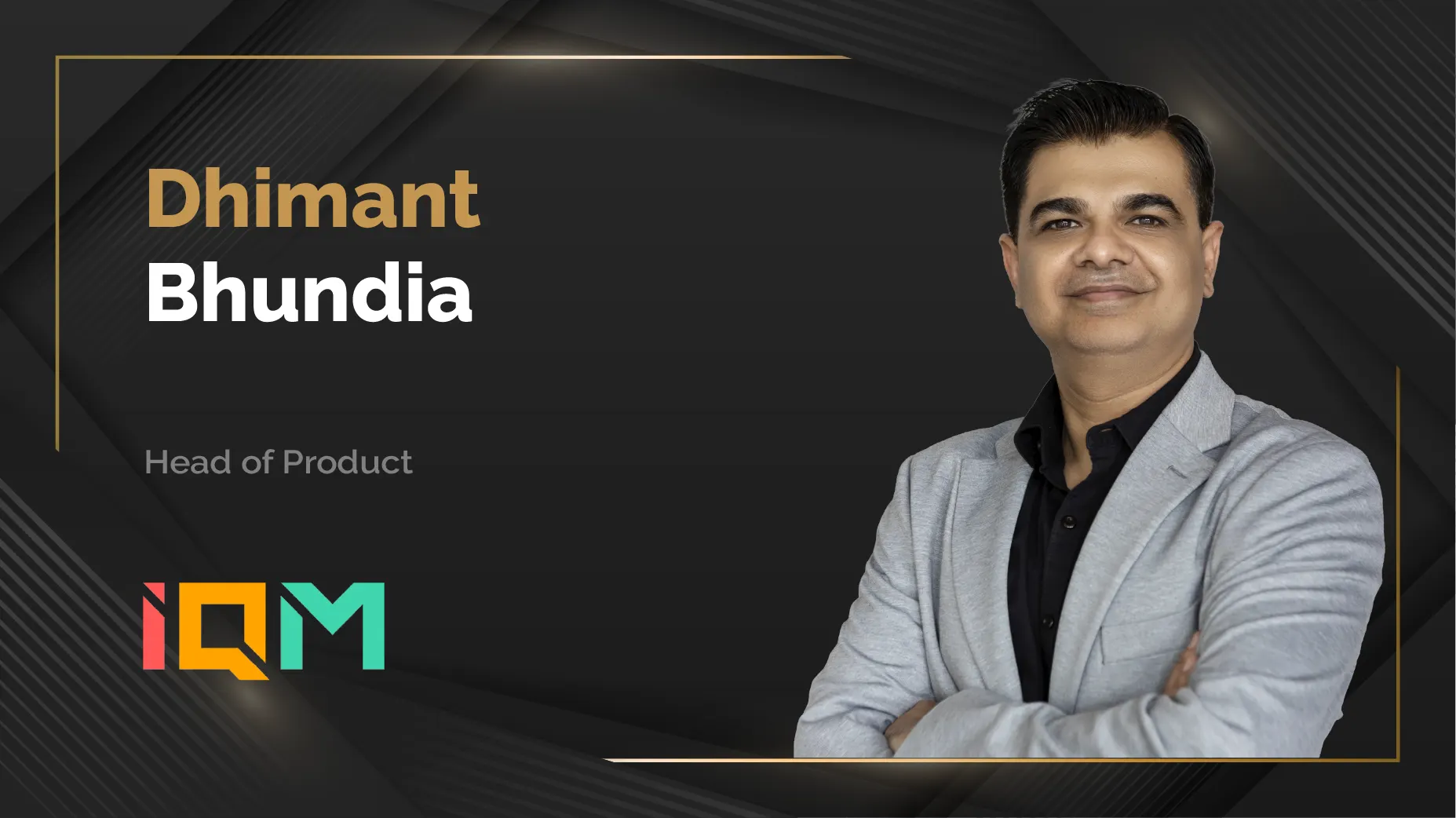
Dhimant Bhundia is the Head of Product at IQM, with over 15 years of experience across data, AI, ad-tech, and mar-tech. Over the course of his career, he has driven product strategy that balances innovation with trust, compliance, and measurable impact. Known for shaping products in highly regulated verticals such as politics, Dhimant focuses on building solutions that align technology with customer needs while ensuring transparency and performance. His leadership emphasizes ethical design, simplicity in complex systems, and creating long-term value for both advertisers and end users.
IQM is a global media buying platform that empowers political, healthcare and other specialty advertisers in highly regulated verticals to use and enhance their data to make better ad buying decisions.
Our platform allows advertisers to construct precise audience segments that align seamlessly with their desired target audience base, using their own data, top-tier third-party data sources, and IQM’s proprietary AI-driven audience intelligence engine. This leads to more accurate forecasting, budgeting and targeting, as well as delivering campaigns that perform better across screens and formats.
Comments are closed.