

Stop treating every hour of work as something that has to be sold. The traditional rule in services firms is simple: if it’s not billable, it’s a cost—but that mindset can quietly limit how a business scales. What feels financially disciplined in the short term can become a growth constraint over time. The firms pulling ahead are the ones responsibly creating non-billable capacity to build leverage-through reusable IP, better systems, and stronger leadership-so they can scale with structure and insight, not just effort.
You grew Velir into a 250-person agency with a successful exit. When you look at that decade-long journey, what is the single most important operational ‘truth’ you learned that you’ve now made a ‘Day 1’ priority for the founders you work with at Form & Function?
If I had to distill it to one operational truth, it’s this: You can’t scale what you can’t see.
At Velir, the hardest moments weren’t about strategy, they were about clarity. As we grew, the business got more complex, and we had to work even harder to maintain good visibility. The performance of our pipeline, capacity and resource planning, margins, etc., all those signals lived in different systems, different spreadsheets, or worse, in people’s heads.
And when visibility breaks down, decision-making slows. Or, it defaults to instinct. And instinct doesn’t scale.
That’s why, at Form & Function Consulting, we treat operational visibility as a Day 1 priority, not something you “layer in later.”
Because once a company reaches a certain level of complexity, every important decision: when to hire, the type of work to pursue, how confident you are in the forecast, even what’s profitable – these things all depend on having a clear, connected view of how the business is actually running.
So the shift we push early is simple but powerful: Move from intuition to insight.
Build the operational systems and processes where your data is connected, your metrics are defined, and your leaders are working from the same source of truth. Because scaling isn’t just about adding more revenue or people, it’s about increasing the quality and speed of decisions as complexity grows.
Recent industry data shows that while the professional services market is ballooning toward $6.6 trillion, 92% of leaders say their tech investments haven’t fully delivered. From your vantage point, why is there such a massive disconnect between ‘buying the tools’ and ‘getting the results?’
In my opinion, the disconnect is pretty straightforward: most firms are buying tools to fix symptoms versus diagnosing real issues and designing systems that drive outcomes.
Technology on its own doesn’t create performance, it just accelerates whatever operating model it’s dropped into. And in most services firms, that model was never designed to scale in the first place. Systems and processes don’t often break down immediately, their effectiveness erodes over time, and it’s sometimes hard to see the incremental issues until the impact is significant.
Left unchecked, your resourcing process becomes incredibly time consuming, inefficient, and often ineffective. When project onboarding slows and the resource mix is suboptimal, revenue shifts out, and margins suffer. While implementing a PSA platform or upgrading your CRM may seem like the cure, these tools often end up sitting on top of broken workflows. Without recalibrating your pipeline definitions and resource management processes, you’re simply automating a fragmented system.
That’s why leaders feel the gap. They’ve “bought the system,” but they haven’t changed how the business actually runs.
There are three root causes we see over and over:
- No clear operating blueprint. Firms implement technology before defining how they should operate, as in how work flows from pipeline → to delivery → to financial outcomes. So the system reflects today’s inconsistencies instead of tomorrow’s discipline.
- Data without context. Even when the data is there, it lacks shared definitions. What counts as “pipeline”? When is revenue “secured”? What does “utilization” really include? Without that context layer, reporting isn’t very useful.
- Adoption is treated as training, not transformation. Teams are taught how to use the tool, but not how to work differently. So they revert to spreadsheets, side systems, and workarounds, undermining the very visibility the platform was supposed to create.
The key is to flip this around: design the operating model first, align data and definitions second, and implement technology third, as the enabler, not the solution.
You are launching F&FC at a time when firms are desperate for ‘external expertise to plug staffing gaps.’ What was the specific ‘lightbulb moment’ that convinced you to move from being a CEO to an advisor helping other founders solve these complexity issues?
The lightbulb wasn’t about leaving the operator seat, it was about recognizing a pattern I had lived through multiple times.
At Velir, like every business, we went through several growth inflection points. And each time, the challenges looked different on the surface, but underneath, they were the same: what worked at 50 people broke at 100, what worked at 100 strained at 150, and by 200+, the gaps weren’t just inefficiencies, they were impediments to growth.
Early on, we could run the business on instinct. Leadership was close to the work, and information traveled quickly, but as we scaled, that stopped working.
You are still asking the same questions about hiring, capacity, forecasting, and profitability, but the answers take longer, require more interpretation, and often come with less confidence.
Looking back, the real lesson wasn’t just that complexity increases, it’s that: if you don’t intentionally redesign how the business operates at each stage of growth, complexity will outpace your ability to manage it.
That’s the piece I didn’t fully appreciate early enough. And once I started talking to other founders, I realized how common that experience is. Most leaders hit the same inflection points, but they have to learn the lessons the hard way, inside their own business, under pressure.
That’s what led to Form & Function Consulting.
It’s more than stepping in as extra capacity, it’s bringing pattern recognition from having lived those transitions:
- When to evolve your operating model
- Where visibility tends to break down
- How systems and data need to mature alongside the business
- And how to avoid the traps that slow growth or erode margin
The truth is that these challenges are predictable, but sometimes you need the outside perspective to help identify them. If you can get ahead of them, you can avoid the downside and create a business that can scale much more effectively.
Also Read: MarTech360 Interview with David Nelson, Co-Founder and CEO at Limelight
Your new firm emphasizes moving leaders from ‘intuition to insight.’ In an era where 72% of finance leaders cite data integration as their top pain point, how do you help a founder stop ‘guessing’ and start building a truly data-driven operating model?
Most founders aren’t “guessing” because they lack data. They’re guessing because the data isn’t connected, consistent, or decision-ready. The shift from intuition to insight doesn’t start with dashboards or AI, it starts with discipline in how the business is defined and run.
So instead of adding more reporting onto already full plates, we take a very different approach. We rebuild the foundation in three steps:
- Define the decisions first – not the data
We start by asking: What decisions does leadership need to make with confidence? Decisions like: when should we hire? Can we take on more work? Are we on track to hit our number?
Most firms jump straight to metrics – but metrics without decisions are just noise. By anchoring on decisions, we ensure everything we build is tied to action.
- Create a shared context layer across the business. This is where most organizations break down. Pipeline, delivery, and finance all operate with slightly different definitions, even when they may be using the same words. So even when data is “integrated,” it’s not aligned.
It helps to standardize:
- What counts as pipeline (and stages of confidence)
- When revenue is truly secured
- How utilization and margin are calculated
- How capacity is measured and forecasted
This context layer is what makes data usable, not just available.
- Connect systems into an operational backbone. Only after decisions and definitions are clear do we connect the systems (CRM, PSA, financials) into a unified model. Not to create more dashboards, but to create one version of operational truth that reflects how the business actually runs.
- Layer in intelligence, not just reporting. This is where our Executive Companion comes in. Instead of static dashboards, leaders can ask: “If we close 30% of pipeline, where do we have capacity gaps?” “What happens to the margin if we hire 3 senior resources next quarter?” It’s not just visibility, it’s decision support in real time.
The end result isn’t that leaders stop using intuition, it’s that their intuition is now validated and scalable. Because being data-driven isn’t about having more data, it’s about building a system where every critical decision is backed by clear and trusted insights.
You’ve noted that growth often stalls when organizational complexity outpaces operational control. How can a founder tell if their current success is built on a scalable system versus just the ‘heroic effort’ of a few key people?
This is one of the most important, and most overlooked, questions a founder can ask. Because for a long time, heroic effort looks exactly like a scalable business – revenue is growing, clients are happy, and the team is pushing hard. But underneath, the system isn’t carrying the load, the people are.
The simplest way to tell is this: if you removed a few key individuals tomorrow, would the business still run the same way? Or would it slow down, or become inconsistent? If the answer is the latter, you don’t have a scalable system yet. There are a few very clear signals we see:
- Answers depend on who you ask. Ask three leaders about the health of the business, and you get three different answers. That’s more than a data problem, that’s a definition problem.
- Critical processes live in people’s heads. Your best folks “just know” how to make things work – how to staff projects or navigate delivery issues. But that knowledge isn’t codified. It’s not repeatable, and it doesn’t scale.
- Reporting is manual and reactive. If it takes days (or weeks) to assemble a view of the business. By the time the picture is clear, it’s already outdated.
- Hiring feels like the only solution to every problem. When systems don’t scale, the default response is to add more people. That often compounds the issue, because complexity increases faster than clarity.
- Leadership is too close to the work. If senior leaders are still deeply involved in day-to-day delivery or constantly resolving issues, it’s usually because the system can’t operate without them.
Market trends suggest that Human + AI hybrid teams are becoming the default operating model for 2026. How is F&FC helping services firms redesign their workflows so that AI acts as an ‘operational partner’ rather than just a shiny new tool?
Most firms are still treating AI like a tool you plug into existing workflows, but the real shift is recognizing that AI changes how the business operates when paired with human judgment.
That means connecting core operational data, cleaning up definitions, and then using AI to answer real questions like: Do we have the capacity to take on this work? When should we hire? Where are we at risk?
The model is simple: AI helps do the heavy lifting on analysis, and leaders use that to make better, faster decisions.
It’s not about replacing people or reinventing everything. It’s about making the business easier to understand and run as it grows.
That’s when AI stops being a “feature” and starts acting as a true operational partner.
With private equity now invested in over half of the largest 30 accounting and services firms, the pressure for discipline is higher than ever. Having led Velir through a PE sale yourself, what is one ‘PE-level’ discipline that even small, founder-led firms should adopt today?
Treat your forecast as a system of record, not a monthly report.
In many founder-led firms, forecasting is still a periodic activity, rebuilt in spreadsheets, discussed in meetings, and often inaccurate when reviewed in retrospect.
PE-backed firms don’t operate that way. They build a continuous forecasting discipline where pipeline, backlog, and financials are connected, so at any point in time, you can answer:
- How much of our revenue is truly secured vs at risk?
- Do we have the capacity to deliver what we’re selling?
- Are we on track to meet our budget, and what can we do if we are off track?
This way, you have a deeper understanding of the texture of the business and a perspective that leadership can trust.
That level of visibility is what investors expect, and it’s just as powerful for founders who want to scale with confidence.
Many leaders see ‘operations’ as the back office, but you treat it as a growth engine. How do you shift a leadership team’s mindset to see operational clarity as a competitive advantage that allows them to move faster than their rivals?
The shift of connecting operations to growth happens when leadership teams understand that a business’s ability to scale is directly related to how quickly and confidently decisions are made. And the ability to make the right decisions hinges on having good visibility into the performance of the business – the hallmark of operations.
In firms without good operational visibility, every important decision slows down:
- Can we take on this work?
- Do we have the capacity to start now??
- How should we price it?
Answers take time, require discussion and/or debate, often come with low confidence, or rely solely on instincts. That friction compounds as the business grows.
When we help teams tighten their operating model (connecting pipeline, delivery, and financials) and align on shared definitions, something changes. Decisions that used to take days or longer happen immediately, leaders stop second-guessing numbers, and the organization starts moving with far more coordination. That’s when it clicks.
And in a services business, the firm that can see clearly and act quickly will consistently outperform those that are reacting, no matter how strong the strategy is.
As you officially launch, what does the ideal ‘Form & Function’ client look like? What is the specific ‘fire’ they are usually trying to put out when they realize they need your help?
We are looking to engage with services businesses that are at a particular inflection point in their growth. We generally group them into three archetypes:
- Scaling Operator: You are growing: more clients, more projects, more people. What was once manageable through a small leadership team now requires more structured systems, processes, and visibility to operate effectively.
- Pre-Transaction Builder: The business is preparing for a sale, acquisition, or investment. Clearly understanding performance, scalability, and operational readiness becomes essential to support the next phase.
- Value Creator: Post-acquisition, the focus shifts to executing the growth plan with greater visibility, consistency, and operational discipline.
Looking ahead, if a founder is trying to scale a consulting business today, what is one ‘old rule’ of service-firm management (like the billable hour or traditional hierarchy) they should consider breaking to stay relevant?
I’d push on something even more fundamental: Stop treating every hour of work as something that has to be sold.
The traditional rule in services firms is simple: if it’s not billable, it’s a cost. This is true, but that mindset can quietly limit how a business can scale.
I learned this the hard way.
Early on, we were too conservative with investment – holding the line on utilization, delaying hires, and underinvesting in new capabilities and systems. On paper, it looked efficient, but in reality, it slowed us down. New offerings took longer to gain traction, leadership stayed too deep in delivery, and we didn’t build the infrastructure we needed until the pressure forced it.
That’s the trap: what feels financially disciplined in the short term can become a growth constraint over time.
The firms that are pulling ahead are breaking that rule. They’re responsibly creating capacity that isn’t directly billable, and using it to build leverage into the business:
- Developing reusable IP and delivery models
- Investing in data, systems, and AI to improve decision-making
- Building senior capacity to look ahead, not just deliver today
Understanding how and where to invest time and resources effectively is what separates a firm that has to earn every dollar through effort from one that can scale with structure and insight.
Thanks Dave!
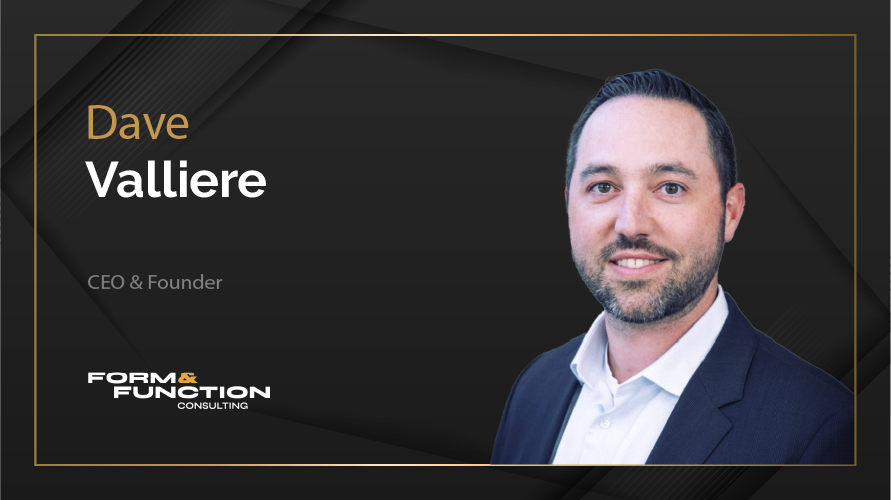
Dave Valliere comes across as a pragmatic, growth-focused executive who blends strategic vision with operational discipline. As the Founder & CEO of Form & Function Consulting, he appears to position himself less as a traditional consultant and more as a hands-on advisor who helps organizations translate complex transformation goals into executable outcomes.
Form & Function Consulting helps services organizations transform operational complexity into a competitive advantage. We work directly with leadership teams to diagnose the constraints limiting growth and redesign operations around the drivers of performance – how businesses win work, deploy talent, deliver value, and manage performance. Traditional consulting is often built on billable hours and an army of analysts, but we believe there is a better way. Our approach combines management consulting expertise with an AI-Powered Executive Companion that surfaces business insights, benchmarks performance, and models decisions in real time. It functions as an extension of your leadership, finance, and account teams – built to support action, not just reporting.
Comments are closed.