
The Answer for Marketers to America’s Growing ‘Trust Deficit’

Advertisement
It’s getting harder to know what to trust. In fact, there is a widening gap between what the public expects from news journalism (accuracy, neutrality, accountability, credibility and overall quality) and what they believe they are actually getting, otherwise referred to as a ‘trust deficit.’
Every day, Americans of all ages scroll past breaking news alerts, political arguments, conflicting takes and AI-generated images on social media, often before they’ve finished their morning coffee. Information moves faster than ever, but many people often find themselves questioning what feels credible, what feels biased and what might be completely misleading, or even worse, deliberately wrong.
As audiences navigate uncertainty and disinformation, trust quickly becomes one of the most valuable things a media platform can offer.
In a series of studies based on custom research from VAB in partnership with Dynata, viewers across political affiliations, age groups and income levels and diverse communities overwhelmingly pointed to multiscreen TV news as the most trusted source of information compared to social media, search platforms and AI. In fact, when compared to social media, TV news is trusted nearly 9x more by potential voters and almost 13x more by affluent households.
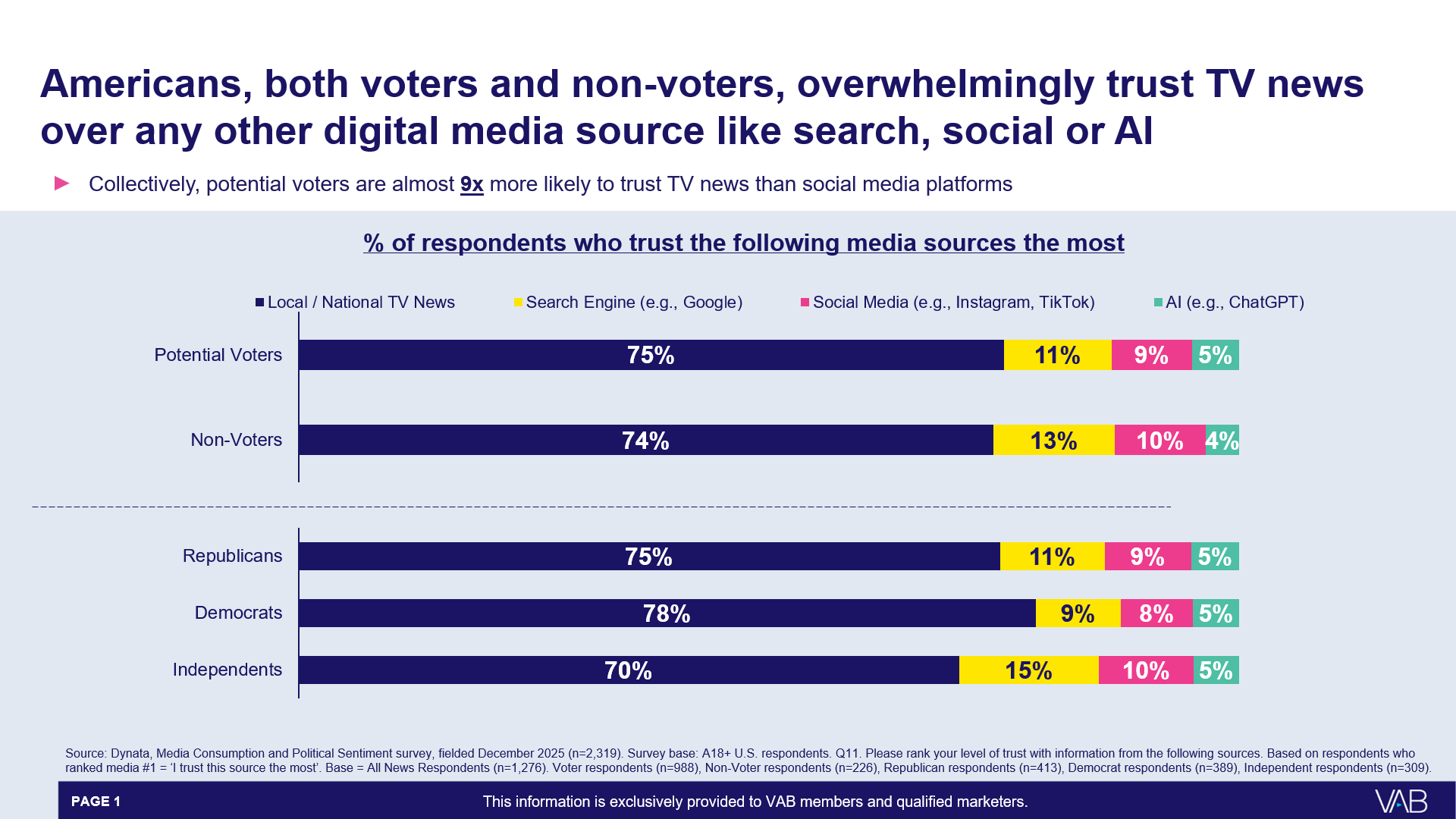
Audiences consistently view social media as more likely to spread fake or misleading information.
Potential voters are nearly 3x more likely to believe social platforms provide misleading information compared to TV news. Even among younger audiences, there is a growing concern about the reliability of online content, with 87% of adults 18-34 expressing concern around the use of AI in the media. These findings reflect a broader shift in how people are approaching content today. Although audiences are consuming information more quickly, they’re also becoming more intentional about where that information comes from.Also Read: Are Marketers Buying Growth, or the Illusion of It, Through Online Advertising?
This explains why so many Americans turn to TV news during the moments that matter most.
Trust extends beyond the national headlines. Whether it’s the election cycle, breaking news or a story impacting local communities, multiscreen TV plays a central role in how people stay informed and it’s where people habitually tune into first for reliable and credible coverage of these events. Most importantly for this current mid-term election season, potential voters are 60% more likely to tune into TV news than social media platforms to stay informed on political issues. They are also almost twice as likely to first learn about political candidates from multiscreen TV compared to social media. For many viewers, TV news serves as the starting point for understanding major stories and events, while social media plays more of a supplemental role. At the local level, TV news plays a unique role in creating connection and relevance within diverse communities. Across Black, Hispanic and Asian audiences, viewers consistently cited local TV news as an important source for community-focused stories, local perspectives and trusted personalities. Our research found that local news strengthens engagement because it also connects national issues back to people’s daily lives and local communities. Diverse audiences also express stronger appreciation for the honest, unbiased and straightforward perspectives they associate with TV news programming. The findings also challenge some common assumptions about who watches and values TV news today, as there is growing engagement across younger demographics. In fact, 58% of adults 18-34 reported watching more multiscreen TV news, highlighting how credibility and reliable information are becoming increasingly important across generations in today’s hyper-fragmented media environment where trust is at a premium. There is a halo effect from trusted TV news programming that extends to its advertisers. Trust in multiscreen TV news environments also influences how audiences feel about its advertisers. Many viewers are more likely to have a favorable opinion of brands that advertise alongside TV news programming, both national and local broadcasts and related content across screens. Among younger adults, 47% of adults 18-34 reported having a more favorable opinion of advertisers appearing in local TV news. High-income households are more than twice as likely to purchase from advertisers that are seen during national TV news programming. The same pattern appeared around political programming as well. Potential voters were 50% more likely to purchase from advertisers adjacent to a televised political debate or town hall, reinforcing how trusted environments can positively shape advertiser perception and brand favorability. For advertisers that may question what role they may inadvertently be playing in the growing ‘trust deficit’ in America through their media buys, they can find their answer by aligning with multiscreen TV news programming which brings the credibility, accuracy, accountability and quality that people desire. Not only is this good for the American public but it’s also good for business.Advertisement