

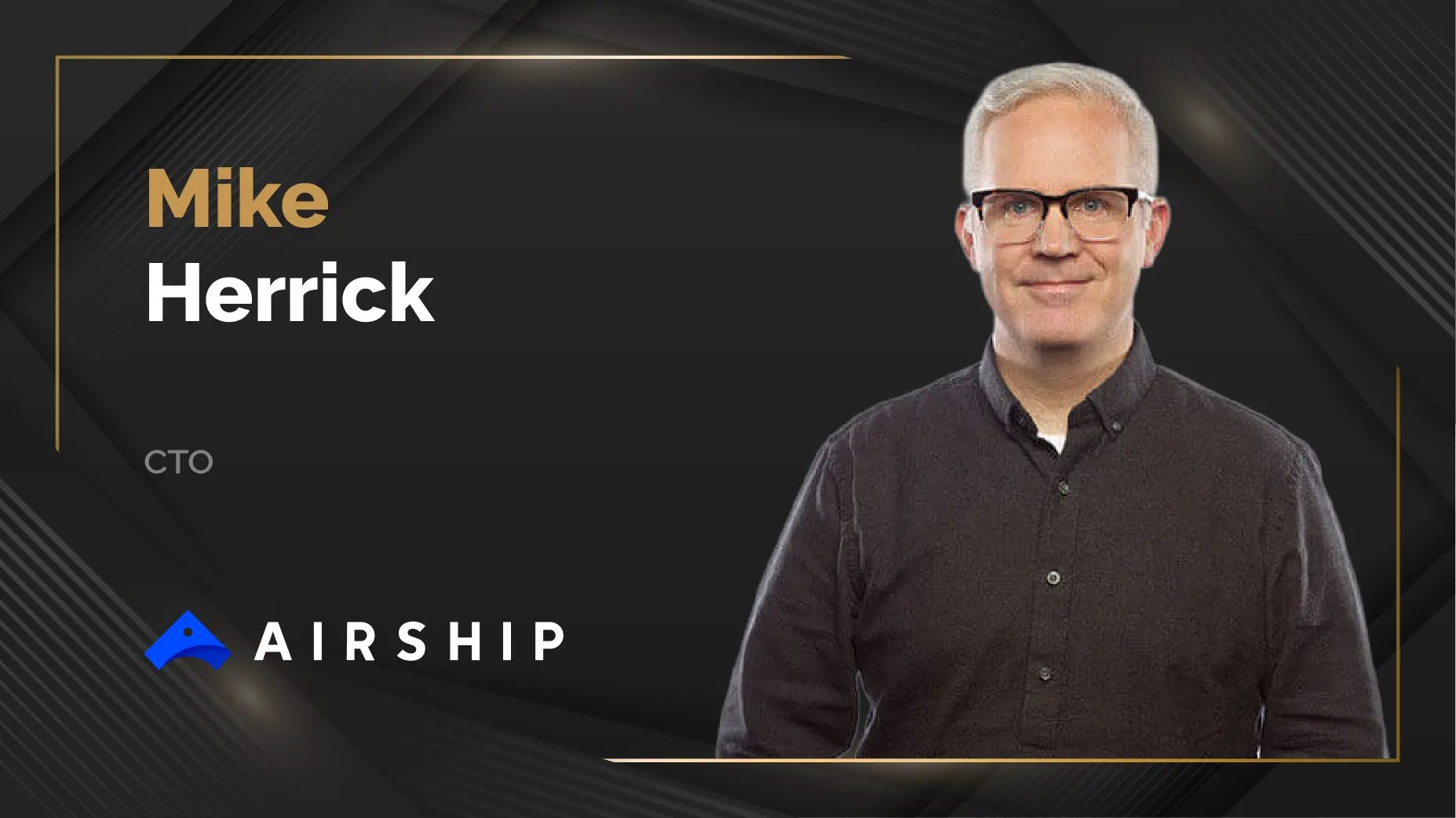
Listen to your customers and to everyone on the team: product, design and engineers. These are often where some of the best ideas come from, and you’ll be well-served to resist strict hierarchy and role definitions. Above all, be creative!
Mike, can you tell us about your professional background and your current role at Airship?
My journey with Airship goes back 15 years — I was employee #5, joining in 2010. Throughout my tenure with Airship, I’ve led our technology and product organizations through a rapid mobile-first evolution; powering the first push notifications, the first in-app messages and the first mobile wallet passes. That history of industry-first mobile innovation became Airship’s ethos. We helped Google adopt wallet boarding passes and tickets. We helped brands adopt Apple Live Activities (including inventing Airship Live Updates for Android) and we most recently enabled Live Activities on mobile wallet passes. We also added every marketing channel to our AI-powered cross-channel customer experience platform, allowing brands to engage customers across all channels (e.g., email and SMS) through to native app and web experiences where personalized, dynamic content accelerates conversions. Prior to Airship, I held leadership roles across product management and technical development at a number of global tech companies, which gave me a broad understanding of the software business.
My current role as Chief Technology Officer is to lead the company’s technology vision, overseeing all of product, engineering, infrastructure and security. It’s a role that centers on discovering, developing, operating and sustaining the Airship Experience Platform, ensuring we’re building technology that enables our customers to accelerate time-to-value and get mobile-first customer experience right, growing both immediate and long-term value for their businesses.
Tell us how Airship differentiates itself from other companies in the same space?
Many Multichannel Marketing Hubs offer a wide array of features across channels, and both martech and adtech, aiming to be a “one-stop shop.” While this breadth can be appealing, it often comes at a high cost and lack of expertise, depth and agility, particularly when it comes to serving mobile-first customers — which today, is most of them.
At Airship, by contrast, we’ve meticulously engineered a platform that addresses the precise needs of modern, mobile-first customer experiences. Our unique capabilities are purpose-built to overcome silos across channels, data and teams, ensuring consistent, cohesive customer experiences, while super-charging the entire creation-to-optimization process. While most platforms focus on orchestrating messages across channels — that’s usually just the beginning of customer journeys. Conversion and value happen within customer experiences on apps and websites.
Airship uniquely connects messaging, in-app and web experiences, real-time data and AI-powered automation and experimentation to empower growth-focused teams to continuously optimize business outcomes at a speed and scale previously impossible — all without needing developer support.
As someone bridging product and engineering, how do you ensure alignment between these functions, especially as you continue to build out the Airship Experience Platform?
Alignment at Airship is not about process. It’s about a shared commitment to a very small set of company priorities. We drive this through what we call “Very Few Objectives” or VFOs — typically centered on accelerating business growth and customer success, and gaining broader recognition of our differentiated capabilities and expertise.
Every year, our executive team establishes a focused set of outcomes that will create the greatest impact for our company and the greatest value for our customers, ensuring every team is marching toward the same goals. This simple framework helps us overcome the natural tension that exists between functions, and provides the necessary focus to continue our rapid pace of innovation while maintaining profitability — something I’m proud to say we’ve achieved since 2018.
Airship pioneered many ‘firsts,’ push notifications, in-app messaging, mobile wallet boarding passes, Live Activities, and the no-code native experience editor. Which of these innovations stands out for you most, and what drove that breakthrough?
Powering the first push notification was a watershed moment for the entire mobile industry, giving apps a voice and lifeline to grow customer retention and value. However, the innovation that stands out most right now is Airship’s no-code native Experience Editor. It revolutionizes marketers and product owners’ ability to optimize the entire customer experience — from highly personalized cross-channel messaging through to resulting experiences on brands’ critical conversion destinations, their apps and websites.
We created a domain-specific language that takes what non-technical teams create in an intuitive, easy-to-use editor and translates it into native code for iOS and Android apps and websites. This ensures that app and web experiences designed to better onboard, activate, convert and understand customers load fast, are accessible and have measurement built-in. Best of all, anyone on your team can create, deploy, test and adapt these experiences to better achieve specific business goals without developer support.
The breakthrough, while born from Airship’s app expertise, also factors heavily on websites too — nearly three-quarters of marketing and product owners think about user experience improvements weekly, but 95% of them rely on developer resources to make them happen. And no surprise, these enhancement requests are nowhere near developers’ top priorities. Their focus is on developing new, market-differentiating features and fixing bugs. Further, virtually all marketers and product owners agree that waiting for these enhancements significantly impacts business results.
We’re taking these capabilities that empower non-technical teams to the next level with Airship Journeys AI and most recently Airship AI Agents. In one click, marketers can turn goals and prompts into complete customer journeys — auto-generating message content, orchestration and app and web experiences they can fine tune. Our new AI Agents help teams automate the entire creation-to-optimization process. Agents work independently or in tandem, alongside their human bosses, to create, test and optimize cross-channel messages and app and web experiences to best achieve specific business goals — closing the loop between testing, learning and action at a speed and scale that was previously impossible.
The platform’s no-code experience editor empowers marketers and product teams to move quickly without engineering. How do you balance ease-of-use with managing complexity behind the scenes?
First, our no-code Experience Editor is very easy to use, and it has an AI co-pilot where marketers can upload images from tools like Figma to jumpstart experience designs. It offers full design control and precise previews, and built-in A/B testing, feature flags and controlled rollouts provide both marketers and developers the freedom and confidence to rapidly innovate, mitigate risks and optimize results prior to a full-scale rollout. Airship offers a variety of customizable no-code experiences for apps and websites including multiscreen Scenes, rich and immersive Stories, and Embedded Content that seamlessly integrates into apps and websites supporting dynamic, personalization. No-code Surveys and Forms allow marketers and product owners to easily collect feedback and first- and zero- party data that’s instantly available to fuel the next personalized experience. One customer, Orange France, saw a 30X increase in customer survey responses by shifting from in-app surveys delivered as HTML webviews — a distracting and disjointed user experience — to surveys delivered as native app experiences with no coding required.
Airship AI Agents automate the creation, testing and optimization of these no-code experiences and include an Accessibility Agent that proactively generates elements to ensure experiences are built to meet accessibility requirements and critical standards like the new EU Accessibility Act that went into effect June 28, mitigating significant legal and financial risk. In addition, Airship Brand Hub underpins all agents to ensure every piece of AI-generated content, from app and web experiences to cross-channel campaign copy uses the brand’s style guide adhering to the company’s unique voice, tone, and visual identity. It solves the core tension between generating content at speed and scale, while maintaining brand integrity.
Also Read: MarTech360 Interview with Piero Pavone, Founder and CEO at Preciso
AI is central to Airship, predictive recommendations, journey orchestration, content creation. What are the most valuable AI-driven capabilities you have delivered, and what is next on the Horizon?
The volume of digital interactions and the growing need to address customers personally — all the way down to audiences of one — present an extraordinary demand on brands for content creation. AI is changing the game, helping brands move faster and smarter and go beyond meeting expectations to setting entirely new ones. Our AI-powered solutions empower marketing teams to quickly and efficiently create highly personalized campaigns. For example, Airship Journeys AI streamlines the entire process by suggesting optimal customer journey flows, generating cross-channel messages, and building no-code app and web experiences that non-technical teams can easily adapt, deploy and optimize. Our AI Agents hold tremendous potential to continually unlock greater value, making it even easier to enable continuous optimization tied to specific business outcomes.
Given the rapid expansion of generative AI, how does Airship prioritize safety, ethical development and brand integrity?
Responsible AI is non-negotiable and it’s foundational to earning customer trust. We leverage state-of-the-art AI capabilities through Google’s Vertex AI platform to empower marketers to achieve greater efficiency and effectiveness while maintaining the highest standards of data privacy and ethical use.
Our AI solutions are designed with a fundamental “human in the loop” philosophy, ensuring that while automation and AI-driven insights enhance marketing capabilities, human judgment and oversight remain central to the decision-making process. This balanced approach allows our customers to benefit from AI’s transformative potential while maintaining control over their brand voice, customer relationships and strategic direction.
Trust forms the foundation of our AI strategy. Through transparent practices, clear communication about how AI is used, and robust security measures, we build and maintain trust with both our customers and their end-users. Our commitment to data protection ensures that customer information is used solely for its intended purpose.
Airship’s core value is investing deeply in customer success, which fuels your innovation. Can you share an example where direct customer collaboration led to a breakthrough feature or direction?
Most of Airship’s innovations are rooted in customer needs — expressed or not. As mobile platforms roll out new capabilities, we often work with marquee brands to leverage our industry-first support, ensuring referenceable examples at launch of how companies are adopting new features to benefit their end users. Through Airship’s long history there are many different examples of collaborative innovations from message throttling to ensure customer response to real-time notifications did not overwhelm businesses’ internal systems to persistent in-app inboxes where companies wanted to provide rich content customers could consume at their own convenience. Outside of our AI innovations, recent examples of collaborative features have included Embedded Content as companies desired ways to personally engage their customers in-session in highly personal, non-interruptive ways.
In addition, Branching and Custom Views enable marketing, product and growth teams to move beyond generic, one-size-fits-all digital experiences and avoid the costly time and resource drain of rebuilding proven native content for novel uses. Branching allows marketers to craft responsive experiences for apps and websites that keep customers engaged by intelligently skipping irrelevant steps or instantly pivoting to relevant content based on their behaviors and expressed interests. Custom Views empowers marketers to dramatically increase efficiency and consistency by reusing existing, high-performing native elements from their app or website — such as interactive maps, shopping carts, saved favorites or lists, booking interfaces, loyalty dashboards or even native ad units — directly within their cross-channel experiences. This eliminates redundant development, accelerating the launch of richer, more functional, high-quality customer experiences across all digital touchpoints.
Looking ahead in a mobile-first world, what emerging trends, whether shifts in data privacy, AI, omnichannel marketing, or something else, do you believe will most influence how customer experience platforms evolve?
During my time at Airship, I’ve watched mobile completely transform the way brands interact with customers, and what customers expect from brands. Strategic conversations have progressed from “do we need a mobile strategy” to “how do we unify mobile interactions everywhere to both provide and capture more value throughout the customer lifecycle.”
Now, marketers are facing a new challenge as consumers move between an ever-growing number of channels, platforms and devices. For growth teams tasked with bringing customers to brand-owned destinations — apps, websites and physical locations — this fragmentation presents a real challenge. The most successful brands reach customers in a way that matches how they consume content today — carrying their context and preferences across channels and destinations to the one screen always on hand.
What advice would you give to aspiring CTOs and product or engineering leaders on the mindset shifts and principles that shaped your success?
Mobile introduced a frantic pace of innovation that still continues a decade-and-a-half later, and AI is now poised to amplify this exponentially. Personally, this requires staying curious, being focused, working hard and loving life and humanity. Listen to your customers and to everyone on the team: product, design and engineers. These are often where some of the best ideas come from, and you’ll be well-served to resist strict hierarchy and role definitions. Above all, be creative!
Additionally, in my experience there are no rewards for processes. You and your team must find ways to deliver. For product organization leaders this means experimenting with new processes and making them your own.
Thanks Mike!
Mike Herrick, Chief Technology Officer at Airship, leads the company’s technology vision across product, engineering, infrastructure, and security. With a focus on advancing the Airship Experience Platform, he drives innovation that helps businesses accelerate time-to-value and deliver seamless, mobile-first customer experiences. Under his leadership, Airship continues to enable brands to achieve both immediate impact and long-term growth.
Airship is a leading customer experience platform helping brands deliver seamless, mobile-first interactions across apps, web, and digital channels. In a landscape where customer journeys are often fragmented, Airship stands out by enabling companies to unify engagement and create connected experiences that drive retention and growth. With its expertise in mobile innovation and cross-channel orchestration, Airship empowers businesses to meet rising customer expectations and achieve measurable impact at scale.
Comments are closed.