


For years, Web Push notifications were considered one of the easiest ways to drive instant user engagement: fast delivery, low entry barriers, and strong performance across multiple verticals. But over the past two years, the landscape has become far more complex. Stricter policies, growing privacy expectations, and increased focus on user experience have reshaped how the channel operates.
This creates an important question for advertisers and publishers alike: is Web Push gradually losing effectiveness, or is the industry simply entering a new stage?
In this article, we’ll examine the current state of the Web Push advertising market, the major developments shaping it in 2026 and beyond, and the opportunities that still remain for those prepared to adapt to the new reality.
Major changes started in 2024-2025

Back in late 2024, Google made unsubscribe buttons more prominent on Android to improve the user experience. On top of that, the company began blocking content identified as spam or misleading more aggressively to enforce Safe Browsing rules.
We detected a 30–40% spike in unsubscribe rates on our platform alone. Although we managed to get a grip on the situation and helped our clients return to their usual numbers, the disruption in the market felt ubiquitous, pushing some businesses to their limits.
The situation clearly manifested the advent of wider changes in the Web Push market ecosystem. So what should we expect, and how should we prepare? Let’s first take a look at the numbers.
Also Read: AI-Powered Intent Signals: The New Currency of Digital Marketing
Web Push ad market forecast in numbers
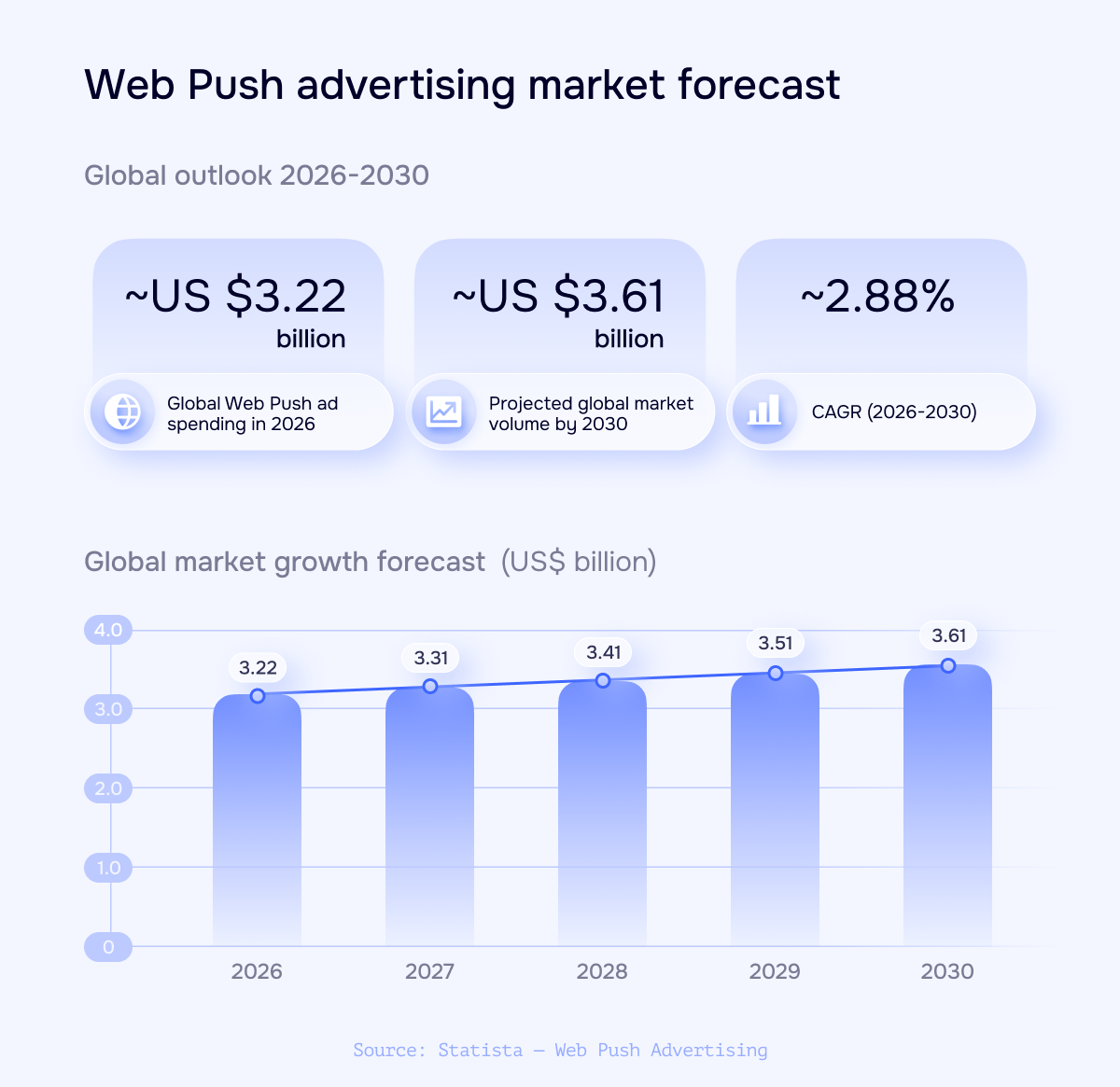
According to Statista’s Web Push Advertising report, global Web Push spending is projected to go from $3.22B in 2026 to $3.61B in 2030, growing at a 2.88% CAGR (Compound Annual Growth Rate).
The forecast shows steady growth and incremental development, suggesting that Web Push advertising is transitioning into a stable, maturity-stage channel rather than continuing its earlier path as a high-growth performance channel.
 Source: RollerAds blog
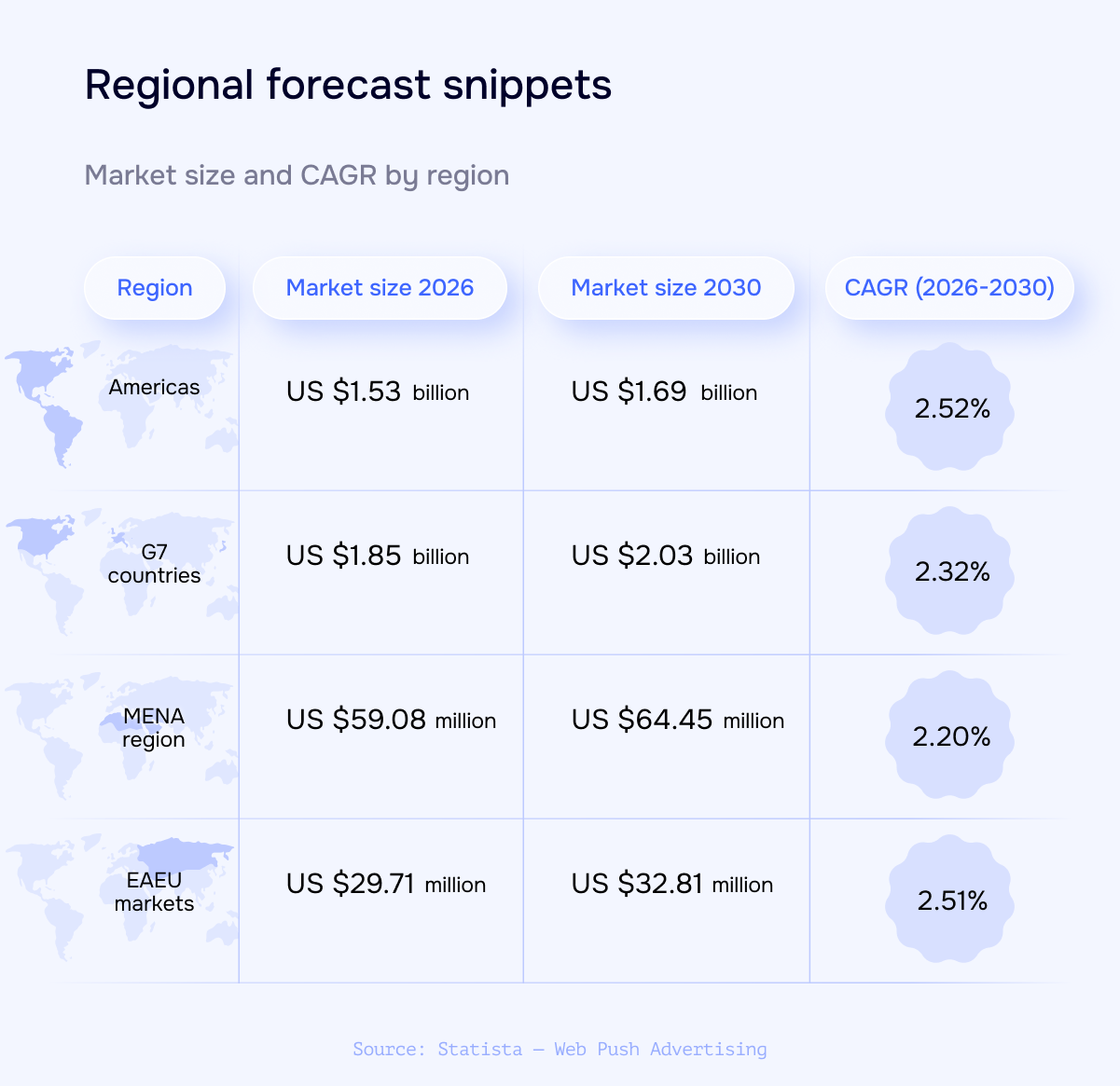
Different regions also show a tempered but stable growth at slightly different speeds.
- Americas:
~US$1.53 billion (2026) → ~US$1.69 billion (2030), CAGR ~2.52% - G7 countries:
~US$1.85 billion (2026) → ~US$2.03 billion (2030), CAGR ~2.32% - MENA region:
~US$59.08 million (2026) → ~US$64.45 million (2030), CAGR ~2.20% - EAEU markets:
~US$29.71 million (2026) → ~US$32.81 million (2030), CAGR ~2.51%
 Source: RollerAds blog
The general pattern remains the same across regions: Web Push advertising continues to deliver results and develop steadily, albeit in small steps.
Web Push trends and insights
Building on Statista’s outlook, Web Push advertising is expected to keep growing. At the same time, platform rules and enforcement are evolving, reflecting a long-term shift in how the ecosystem operates rather than a sudden change.
Overall, the channel is being restructured. Policy tightenings and better detection are reducing low-quality traffic and raising overall standards. This can cause short-term performance fluctuations, but it doesn’t indicate decline. Instead, it points to a move toward higher-quality audiences, which should improve engagement and CTR over time as users receive fewer, more relevant messages.
The market is clearly becoming more quality-focused. Less compliant traffic sources are being replaced by more reliable and performance-driven players. After a relatively balanced phase up to 2024, stricter enforcement has shifted supply and demand dynamics—sometimes increasing costs in the short term, but also improving efficiency for stronger advertisers. Overall, the industry is moving away from a volume-based model toward a performance and ROI-focused approach, where advertisers and traffic providers adapt by improving targeting, optimization, and long-term value (LTV) strategies.
The way forward for the Web Push ad market
The Web Push market is maturing and undergoing structural changes. While some short-term volatility remains, the overall direction is stable and continues to show gradual growth.
According to our platform data, CTR has increased by 1.5–2x over the past couple of years. These are internal observations, but broader market trends appear to reflect a similar path and suggest improving engagement quality across the ecosystem.
For advertisers and networks, success is becoming less about volume and more about relevance, targeting precision, and overall performance quality. At RollerAds, we continuously adapt our tools to align with evolving industry standards and help partners navigate these changes more effectively.
Comments are closed.