

Start by understanding your conversations, especially in voice. That’s where complexity lives, but also where the clearest opportunities are.
Ritu, can you tell us about your professional background and your current role at Observe.AI? Also, how does Observe.AI differentiate itself from other companies in the same space?
I’m the Chief Marketing Officer at Observe.AI. My background spans go-to-market roles across companies focused on AI and automation. What drew me to Observe.AI is the opportunity to modernize one of the most people-intensive, legacy operations in the enterprise: customer service
Our core differentiator is our deep focus and expertise in automating the voice channel, which is by far the hardest channel to automate. Unlike chat or text, voice is messy, fast, and full of nuance. It’s also where the highest-value, most complex customer interactions happen. That’s why we built a purpose-built platform to deeply understand voice conversations, decide which ones to automate with AI agents, which to augment with copilots, and which to leave to human agents. Then we layer in AutoQA, coaching, and analytics to improve outcomes and expand automation over time. That voice-first foundation is what sets us apart.
With Observe.AI delivering generative AI and real-time agent assist, how do you balance the excitement of AI with practical outcomes for enterprise customers?
We focus on solving real problems, especially in voice, where the bar for quality is much higher. Our customers aren’t looking for experimentation. They’re looking for measurable impact: reduced handle times, higher first call resolution, and compliance at scale.
Because voice is more prone to error and harder to govern than text, we’ve made quality and accuracy a core part of our GenAI strategy. That’s why we built Blindspot, a hallucination detection layer that flags when GenAI outputs like summaries or insights deviate from the original call. It’s also why we train on real voice interactions, not just scraped web data. In Agentic AI today, trust has to be earned, and we’ve built our product around that reality.
How do you position Observe.AI’s platform for different stakeholders like CX, Ops, and CIOs?
We meet customers where they are in their AI journey. Some are just starting out, looking to understand what’s really happening in their voice interactions. Others are ready to automate at scale. Our platform supports that full progression.
Our most successful customers use our entire platform – conversation Intelligence built for both voice and text, giving teams visibility into every customer interaction. From there, we help organizations decide which conversations to automate with AI agents, which to augment with real-time copilots, and which should stay with human agents. We then apply QA and coaching to drive performance and use analytics to inform the enterprise on voice of customer.
Every stakeholder benefits from this foundation. For CX leaders, it improves satisfaction and consistency. For Ops, it means scalable QA and more effective agents. For compliance, it brings accuracy and governance. And for CIOs and digital transformation leaders, it’s a clear path to safely and effectively automate customer service calls.
Also Read: MarTech360 Interview with Miruna Dragomir, Chief Marketing Officer at Planable
With rapid growth and platform expansion, how has marketing evolved to support the scale?
In today’s market, buyers are overwhelmed with noise. Every vendor sounds the same: promising automation, AI, and transformation. To stand out, we need a focused, crisp story that is consistent from the first ad to the last demo. That requires tight alignment between marketing and sales, not just on messaging, but on targeting the accounts we actually want to do business with, showing up in meaningful ways, and building trust early.
We focus on doing small things with big impact. For example, we sponsored the FAQ line at our largest industry tradeshow, CCW – a simple but memorable way to position Observe.AI as the brand with answers. That’s the mindset: fewer random acts of marketing, more intentional moments that reinforce our value and differentiate us in a crowded space.
How do you use voice-of-customer insights to shape your marketing strategy?
I use voice-of-customer insights as a strategic compass. They help us shape messaging that mirrors how buyers actually think and speak, not how we hope they do. From sales calls to support tickets, VoC reveals what customers truly care about, whether it’s faster deployment, better ROI, or compliance confidence.
These insights directly inform our campaigns, content priorities, and positioning. Just as importantly, they align our GTM teams around what drives real customer value so we’re not just generating leads, we’re building trust and momentum across the entire journey.
Responsible AI is critical in your space. How do you incorporate trust and transparency into your messaging?
In voice automation, the stakes are higher. You’re not just summarizing a web search, you’re interpreting a customer’s frustration, resolving billing issues, or guiding a healthcare decision. So we put trust and transparency at the center of how we market our AI. By leading with transparency, not hype, we’ve been able to build credibility in a crowded, AI-washed market.
We’re clear about how our models are trained on voice data, not generic text, how we manage hallucinations and how we comply with HIPAA, GDPR, and CCPA. These aren’t footnotes. They’re featured in our demos, sales decks, and case studies. Enterprises want to move fast with AI, but only if they know it’s safe, and we help them get there with confidence.
Observe.AI integrates with CRMs, CCaaS, BI tools, and more. How do you align marketing with product, sales, and partnerships around these integrations?
We align messaging around outcomes, not just integration points. For example, it’s not just that we work with Salesforce. It’s that we can help agents resolve cases faster because their tools talk to each other. It’s not just that we connect with CCaaS – It’s that we enable real-time copilots or automated after-call summaries directly inside their workflow.
Because customer service data is often siloed and hard to analyze, these integrations become the bridge to make that data actionable. Our marketing reflects that. We promote the problems we help solve, smarter routing, faster coaching, and reliable automation where it matters most.
What trends do you think will shape the next wave of customer service marketing, and how is Observe.AI preparing?
The biggest shift we’re seeing is from analyzing voice calls to automating them. AI agents are now capable of handling full conversations end-to-end. But the real challenge isn’t building the AI – it’s deploying it safely, reliably, and in a way that reflects the brand.
That’s where Observe.AI is focused: building production-ready, Agentic AI for voice, with real-time monitoring, closed-loop quality, and grounded models trained on domain-specific data. From a marketing standpoint, we’re evolving alongside the product, educating buyers on what makes automation successful, how to govern AI agents, and how to scale without losing the human element.
We’re also seeing a broader shift from reactive support to proactive, insight-driven service. Enterprise buyers don’t just want automation, they want outcomes. That’s why our messaging centers on how we help brands automate the right conversations, assist agents in the moment, and continuously improve through data.
We stay grounded in customer results and focused on marketing what actually works. At the end of the day, our job is to show how AI can amplify human service, not replace it
What advice would you give to business leaders looking to bring AI into customer service without losing the human touch?
Start by understanding your conversations, especially in voice. That’s where complexity lives, but also where the clearest opportunities are. Use AI to remove repetitive work, not empathy. Automate where it makes sense. Augment where it improves speed and accuracy. And leave space for humans where judgment matters.
The best AI deployments aren’t about replacing people. They’re about helping people do more of the work that matters. That’s what we focus on at Observe.AI every day.
Thanks Ritu!
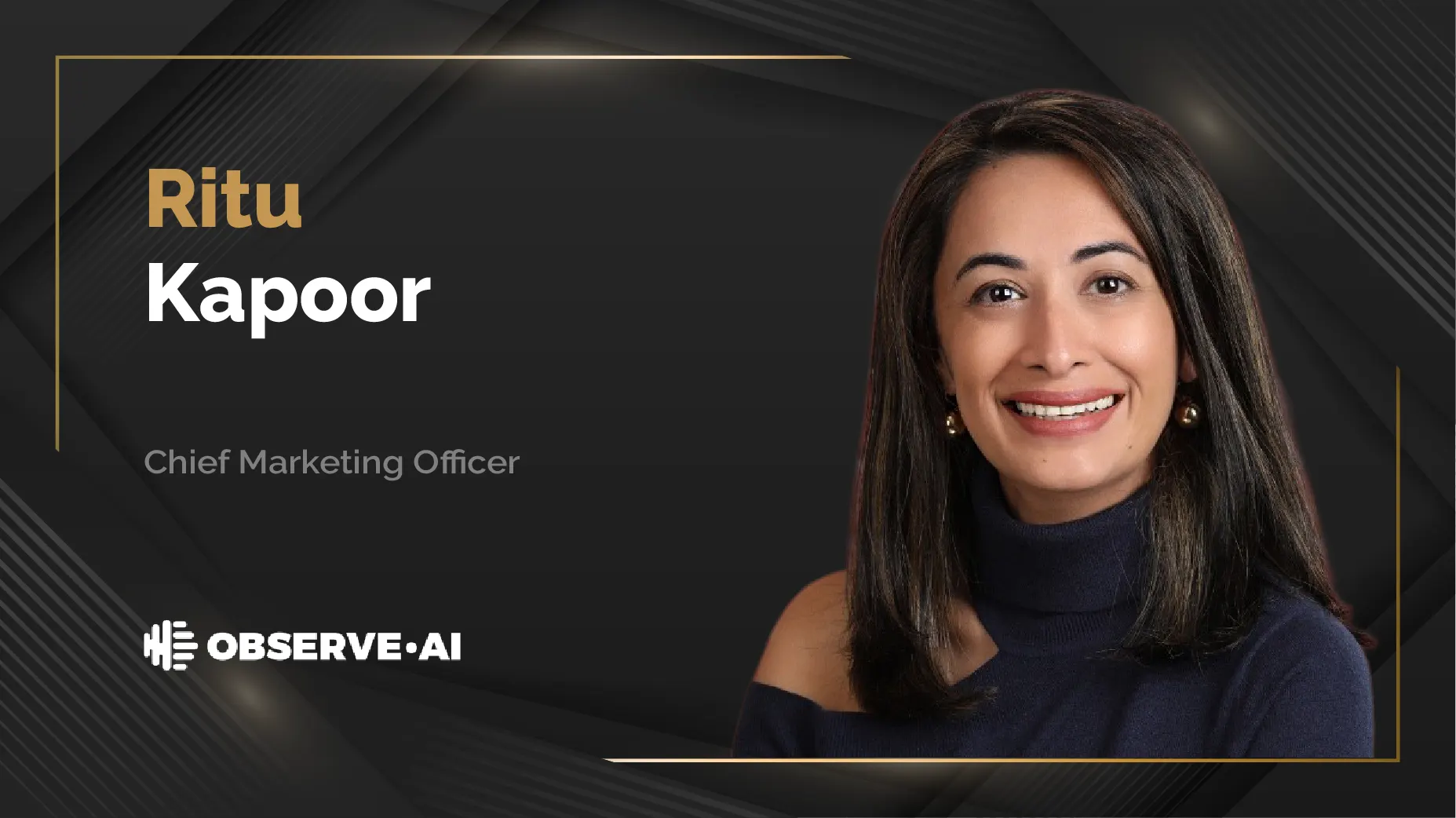
Ritu Kapoor is the Chief Marketing Officer at Observe.AI, where she leads brand, product marketing, and go-to-market for the company’s AI agents platform for contact centers. With an engineering background and an MBA, Ritu has built her career across product, product marketing, and CMO roles focused on automation . She is known for building inclusive, high-performing teams, with a global lens and a builders mindset. Ritu is a frequent voice on bringing enterprise AI from pilot to production
Observe.AI is the leader in AI agents for customer experience. We help enterprises transform how they connect with customers through AI agents and copilots that engage, assist, and act across every channel. From automating conversations to guiding human agents in real time to uncovering insights that shape strategy, Observe.AI turns every interaction into a driver of loyalty and growth.
Trusted by Fortune 500, we’re building a future where every customer experience is smarter, faster, and more impactful. Whether it’s appointment scheduling in healthcare, account servicing in financial services, or reservation changes in travel, Observe.AI powers accurate understanding, natural conversations, and action within real-world workflows.
Comments are closed.